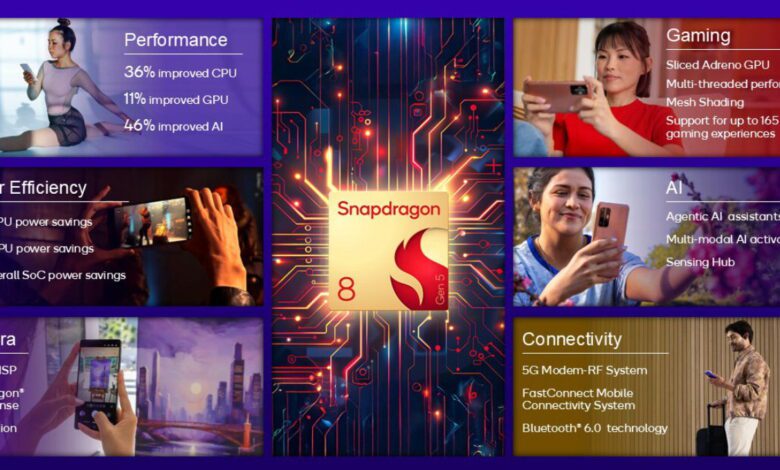
The American company Qualcomm has officially launched the Snapdragon 8 Gen 5 mobile platform, aimed at high-end devices. This new chipset is designed for smartphones and tablets seeking top performance, but without reaching the price and maximum features of the flagship Elite line. The manufacturer focuses on balancing power and affordability to reach users who prefer premium gadgets but are not willing to overpay for the top-tier options.
The Snapdragon 8 Gen 5 is built on TSMC’s advanced 3nm process using N3E technology. The processor architecture features eight computing cores: two high-performance Prime cores and six Performance cores, running at speeds up to 3.8 GHz and 3.32 GHz, respectively. This approach boosts performance significantly over the previous generation—according to Qualcomm, the CPU is 36% faster compared to the Snapdragon 8 Gen 3. The manufacturer also notes that, in real-world scenarios, the difference from the Elite version will be minimal for most users.
The graphics subsystem features an upgraded Adreno accelerator, delivering an 11% boost in performance. Special emphasis has been placed on the neural processing unit (NPU) responsible for AI tasks, which now shows a remarkable 46% leap in efficiency. In addition, the platform supports the latest Bluetooth 6.0 wireless standard and includes improvements in camera functionality and energy efficiency, crucial factors for today’s mobile devices.
Key Features and Advantages of Snapdragon 8 Gen 5
Snapdragon 8 Gen 5 was designed to meet increasingly demanding requirements for performance and battery life. The use of a 3-nm process not only increases speed, but also reduces power consumption, resulting in longer battery life between charges. The integrated Adreno graphics ensures smooth performance in modern games and graphics-intensive applications, while support for new connectivity standards unlocks additional possibilities for users.
A significant innovation is the integration of an enhanced neural processor, which speeds up tasks related to artificial intelligence, image processing, and voice commands. This is especially important for applications utilizing machine learning and personalized user experiences. Additionally, Snapdragon 8 Gen 5 supports advanced camera capabilities, enabling manufacturers to introduce new photo and video shooting features.
First Devices and Manufacturers
The first smartphones and tablets powered by the Snapdragon 8 Gen 5 will go on sale in early 2026. Among the brands that have already confirmed plans to use the new chip are well-known names like Xiaomi, iQOO, Vivo, OnePlus, and Motorola. These companies are expected to unveil their flagship models featuring the upgraded platform during the first quarter of next year.
The launch of the Snapdragon 8 Gen 5 could reshape the balance of power among mobile device manufacturers, as the chipset delivers high performance at a more accessible price point compared to the top-tier Elite series. This creates new opportunities for competition and offers a wider range of options for consumers aiming for the premium segment.
Competitor Comparison and Growth Prospects
Despite Qualcomm’s dominance in the mobile processor segment, the company faces stiff competition from manufacturers developing their own solutions. Chief among them is Apple, whose chips are traditionally regarded as benchmarks for both performance and energy efficiency. Nevertheless, Qualcomm continues to maintain its leadership thanks to a broad product lineup and ongoing innovation.
Experts note that the arrival of Snapdragon 8 Gen 5 could mark a significant milestone in the evolution of mobile technology, especially given the growing popularity of artificial intelligence and new connectivity standards. In the coming years, manufacturers are expected to increasingly integrate such solutions into their devices to meet users’ expectations and market demands.
By the way: what do we know about Qualcomm
Qualcomm holds a leading position in the global semiconductor and telecommunications market. Founded in 1985 in San Diego, the company became one of the main innovators in mobile processors and wireless communications. Qualcomm played a key role in the development of 3G, 4G, and 5G standards, and its chipsets power millions of smartphones worldwide. The brand is known not only for its Snapdragon processors but also for solutions in automotive electronics, the Internet of Things, and network equipment. In recent years, Qualcomm has heavily invested in artificial intelligence and energy-efficient technologies, which has allowed it to remain among the industry’s leaders. Thanks to partnerships with major electronics manufacturers, Qualcomm continues to expand its influence and shape the future of mobile devices.