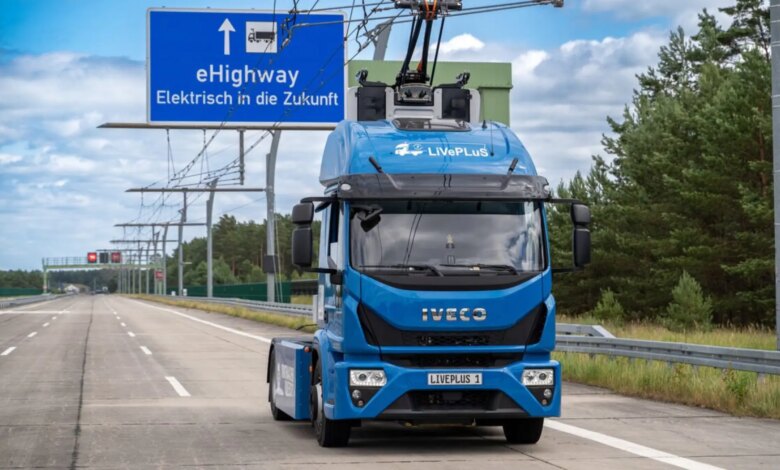
Germany is conducting an experiment that could revolutionize the future of freight transport. Electric trucks have appeared on the country’s roads, able to recharge on the move thanks to an overhead power line system—similar to trolleybuses, but operating under much more challenging conditions. Behind this project are not only the ambitions of scientists, but also nearly six million euros in investment, underscoring the seriousness of the initiative.
The concept is simple, but its implementation is impressive: heavy trucks equipped with special current collectors connect to an overhead contact network stretched across certain highway sections. As the vehicle moves beneath the wires, its batteries recharge, allowing it to cover long distances without frequent stops for charging. This approach promises to reduce reliance on massive batteries and make freight transport more environmentally friendly.
Technology on the move
The project, called BEV Goes eHighway – BEE, is being implemented in partnership with Germany’s leading technical universities, notably RWTH University in Aachen (Aachen). Engineers, together with manufacturer DAF Trucks, modified two DAF XD Electric trucks, equipping them with unique pantographs. These devices automatically rise and lower as the truck enters or exits sections with overhead lines, requiring high precision and reliability for real-world road conditions.
The trials took place on various sections of federal highways, including the regions of Hessen, Schleswig-Holstein, and Baden-Württemberg. During the tests, two prototypes, named “Maya” and “Willi,” covered more than 10,000 kilometers, demonstrating that the technology can operate not only in theory but also in real traffic, under different weather conditions and varying levels of congestion.
Overcoming the limitations
The main problem German engineers are trying to solve is the energy shortage of heavy trucks. Modern batteries, even the most advanced ones, cannot provide long-haul vehicles with the necessary range without frequent stops. The overhead line system allows batteries to charge while in motion, removing some of these limitations and making long-distance travel possible without lengthy downtime.
However, the technology also has its pitfalls. Pantographs cannot remain active at all times: when the catenary section ends or the truck needs to overtake, the device retracts automatically. This requires complex synchronization and reliability, as safety and transport efficiency are at stake.
Infrastructure challenge
Despite its technical success, the project faced a harsh reality: implementing such a system on a large scale requires massive infrastructure. In Germany, as in the rest of Europe, there is not yet an extensive network of overhead lines that can cover the main logistics routes. Building such corridors would require not only billions in investment, but also coordination between regions and countries, making the idea a true challenge for the entire industry.
The industry is in no rush to bet on this option. The reason is simple: conventional electric trucks with large batteries are advancing by leaps and bounds. Today, models capable of traveling up to 500 kilometers without recharging are already on the market, and charging speeds are constantly improving. Additionally, hydrogen technology is looming on the horizon as a potential alternative for long-haul transport.
The future is uncertain
Nevertheless, the German experiment can’t be called a failure. It proved that dynamic charging on the move is not science fiction, but a working technology. The real question is whether Europe is ready to invest in such sweeping changes, as alternative solutions are becoming increasingly accessible and effective.
For now, trucks equipped with pantographs remain a rarity on the roads, and their widespread adoption seems a distant prospect. Yet the very idea of charging heavy vehicles while driving has already become a symbol of the search for new ways to improve the environmental and economic efficiency of transport.
Professor Lutz Eckstein, head of the Institute for Automotive Engineering (ika), emphasizes that dynamic charging is a crucial component among the technologies for decarbonizing freight transport. His colleague, Professor Achim Kampker from the Chair of Production Engineering of E-Mobility Components (PEM), notes that overhead line power can reduce downtime and speed up cargo delivery.
RWTH Aachen is one of Germany’s oldest and largest technical universities, renowned for its cutting-edge developments in transportation and energy. The Institute for Automotive Engineering (ika) and the PEM Chair regularly participate in international projects related to electromobility and sustainable development. Their experiments with electric trucks and the overhead contact line have already attracted the attention of major automakers and logistics companies, and are now being discussed at the European level. Thanks to such initiatives, RWTH Aachen is strengthening Germany’s position as a leader in finding new solutions for the transport of the future.