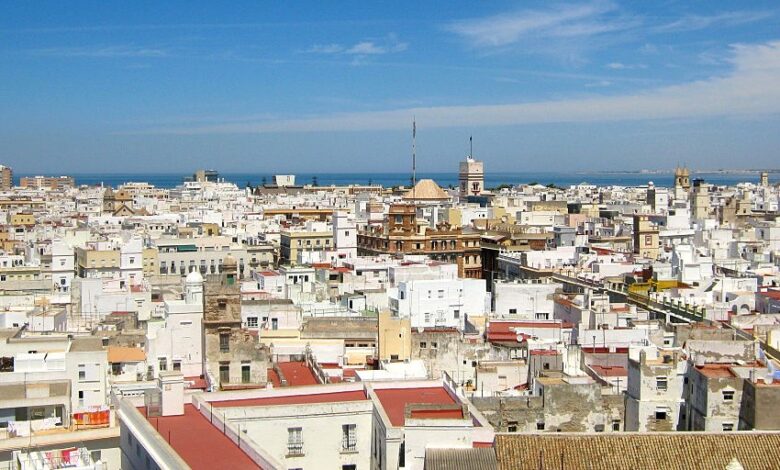
Cádiz is a city best appreciated from above. Its unique position on a narrow peninsula jutting into the Atlantic Ocean makes panoramic vistas not just a beautiful addition, but essential for truly understanding its spirit. It’s no wonder it’s called the “Silver Cup” (Tacita de Plata) — to grasp the shape and brilliance of this cup, you have to rise above its edges. Among historic watchtowers, promenades, and ancient fortresses are vantage points that reveal the true Cádiz: with its ochre rooftops, shining domes, and the endless ocean all around.
The Torre Tavira is, without exaggeration, Cádiz’s top panoramic attraction. Located in the heart of the historic center, inside the old Palace of the Marquis of Recaño, the tower was established in the 18th century—during the city’s golden age of trade with the Americas—as the official observation post for the port. Rising almost 45 meters above sea level, it stands as one of the highest points in the old town, offering a sweeping 360-degree view. But its centerpiece is the Camera Obscura, a unique optical system that projects a live panorama of the city onto a concave screen in real time.
The Cathedral, with its iconic golden dome, is the city’s trademark. Its Clock Tower is the perfect spot to see Cádiz from a new perspective. The ascent might seem tough, since instead of stairs there’s a continuous spiral ramp, but it’s actually quite gentle, and the breathtaking views more than make up for the effort. From the top, you get a privileged panorama of the promenade, the old town rooftops, and of course, a close-up view of the cathedral’s giant yellow dome.
The Campo del Sur Promenade isn’t just a viewpoint, but an entire scenic stretch hugging the southern tip of the old town. Locals call it the “Gaditano Malecón” for its striking resemblance to Havana’s seafront, both in its looks and deep connection to the sea. Here, the views aren’t from above, but they’re completely open. From different spots along the promenade, you can catch the famous shot of the Cathedral framed by the ocean and stone blocks protecting the coast. This is arguably the best place in Cádiz to watch the sunset.
Castillo de San Sebastián, perched at the end of a narrow causeway stretching far out to sea, stands as one of the city’s most unique landmarks. Even if its interior spaces are closed, the walk to the fortress already feels like an adventure, offering shifting perspectives along the way. On one side is the open Atlantic Ocean; on the other, the famous La Caleta beach and the historic facades of the La Viña quarter. From here—right outside the castle—you can witness one of the most stunning sunsets in all of Andalusia.
Casa de las Cuatro Torres is a striking example of 18th-century Cádiz architecture, closely tied to maritime trade. This complex consists of four palaces, united by a single structure and, as the name suggests, four watchtowers at each corner. Today, part of the building has been transformed into a hotel and a cultural venue. From its rooftop, visitors enjoy panoramic views of the port, San Carlos district, and much of the historic center.
Located in the heart of the old town, the Casa de las Cadenas now houses the Provincial Historical Archive. This former palace, built by Portuguese merchant Diego Barrios de la Rosa, has preserved original architectural features on its tower, offering unique vantage points over the city. Behind its austere façade lies a monumental entrance with an impressive Baroque marble portal, and inside, an elegant staircase reminiscent of Cádiz’s commercial golden age.
Cádiz is considered one of the oldest continuously inhabited cities in Western Europe, with a history spanning more than 3,000 years. Founded by the Phoenicians as Gadir, it has always been a strategically important port. The city earned its nickname “Tacita de Plata” (“Silver Cup”) thanks to its dazzling white houses and the bright light reflected from the sea, which from above makes Cádiz resemble a sparkling vessel of silver.