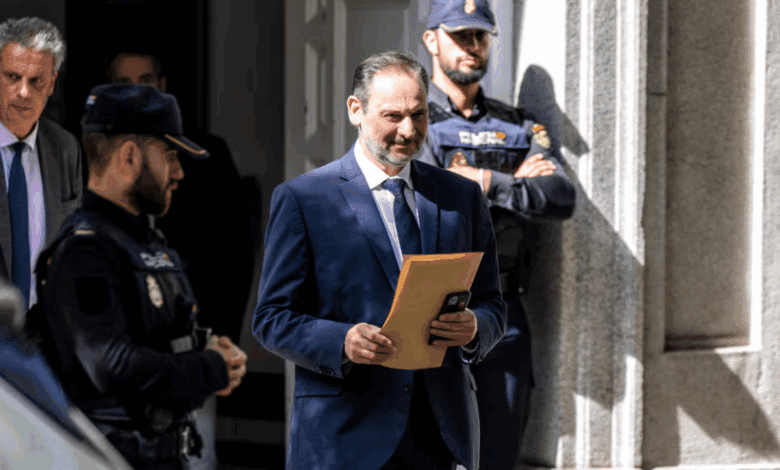
Spain’s Supreme Court faces an unexpected hurdle: the third lawyer appointed to represent former Transport Minister José Luis Ábalos has informed the court that his schedule for February and March is already fully booked with other cases. The court had planned to begin hearings during these months on the high-profile case involving alleged misconduct in state contracts for mask procurement at the height of the pandemic. Now, the trial could be postponed indefinitely.
Marino Turiel, Ábalos’s new attorney, has officially notified the judges about his commitments in several other major cases, including the trial involving former Madrid government adviser Francisco Granados in connection with the Púnica affair. According to the submitted schedule, nearly all dates in February and March are taken, with four more hearings already set for April, May, and June. This puts the possibility of holding the hearing on the previously planned dates in doubt.
Legal obstacles
In a letter to the criminal chamber of the Supreme Court, Turiel listed in detail the dates he is already engaged in other court proceedings. Among them are hearings on charges of illegal contracts between municipalities and the company Waiter Music, with former mayors and senators from the Partido Popular among the defendants. The judges must now take these circumstances into account as they plan the next steps in the Ábalos case.
Court plans and the ex-minister’s defense are clearly at odds. According to legal sources, the Supreme Court had hoped to launch the first hearing in the so-called Koldo case by March at the latest if it couldn’t do so in February. Now, however, that timeline appears uncertain. Moreover, Turiel has stressed that he needs time to thoroughly review the case files to ensure an effective defense for his client. This could further delay proceedings, as the right to a proper defense is fundamental for any defendant.
Change of defense lawyers
Since the Supreme Court officially charged Ábalos in November 2024, the former minister has already changed lawyers three times. For a long period, his interests were represented by José Aníbal Álvarez, but in October they parted ways over what were described as ‘irreconcilable differences.’ Some sources indicate Álvarez advised Ábalos to relinquish his parliamentary seat to prolong the investigation and have the case transferred back to the National Court, but the politician refused.
After that, Ábalos hired former prosecutor Carlos Bautista, who also soon stepped down, citing ‘contractual differences.’ Unofficially, the reason is said to have been unpaid fees. Now, Turiel is handling the ex-minister’s defense, having to urgently familiarize himself with a highly complex case ahead of a key hearing on whether Ábalos and his former adviser Koldo García should remain in custody.
Legal battles
In the coming days, the Supreme Court is set to review the appeal against Judge Leopoldo Puente’s decision to remand Ábalos and García in Soto del Real prison at the end of November. Both Bautista’s former lawyer and the new defense attorney, Turiel—who has also filed the necessary petition—are expected to attend the hearing.
Once this procedure is completed, the case will move to the main trial stage. This will be the first courtroom process in the Koldo case, in which prosecutors suspect Ábalos and his former adviser of receiving bribes—both in cash and through various services—in exchange for lobbying for companies linked to businessman Víctor de Aldama.
Contracts and Accusations
The focus will be on contracts awarded by the Ministry of Transport and its subordinate agencies to Soluciones de Gestión S.L., a company connected to Aldama. This firm supplied masks at the height of the COVID-19 pandemic. According to legal experts, the proceedings are expected to last at least a month due to the large number of witnesses, including the chief of staff to Finance Minister María Jesús Montero and Carlos Moreno.
The judicial panel will consist of seven judges, as is customary in the Supreme Court. The chair of the criminal division, Andrés Martínez Arrieta, will prepare the final ruling, since he was already the rapporteur during the initial acceptance of the case. He will be joined by four other judges who previously supported holding Ábalos accountable, as well as two newly appointed members.
Potential prison terms
Ábalos and his former adviser are accused of forming a criminal organization, influence peddling, taking bribes, and embezzlement of public funds. They face up to 30 years in prison. For Aldama, the prosecution and accusers—including the Partido Popular—are seeking a 7-year sentence, taking into account his guilty plea.
The ongoing changes in legal counsel and the involvement of a new defense attorney could significantly delay the proceedings. When the trial will begin remains uncertain. However, one thing is clear: this case has already become one of the most widely discussed in Spanish legal practice in recent years.