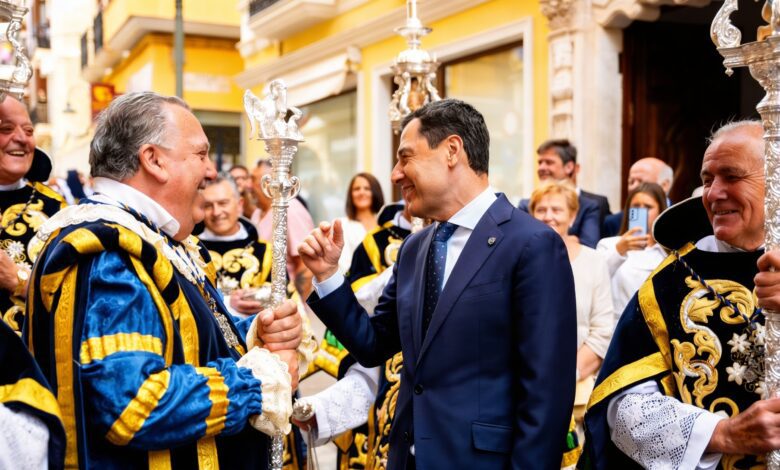
This year, Semana Santa in Andalusia has taken on special significance for the region’s political life. Candidates for the head of the autonomous government have turned traditional religious processions into a stage to showcase their closeness to the people. This behavior by politicians not only changes how the holiday is perceived but also influences voter sentiment ahead of the elections, as noted by El Pais.
The President of the Junta de Andalucía, Juan Manuel Moreno, and the Socialist candidate, María Jesús Montero, are actively using the mass events of Semana Santa to meet with residents. Over the week, they have visited dozens of brotherhoods in different provinces, avoiding standard rallies but gaining wide media attention and reaching potential voters. According to El Pais, the choice of specific processions and brotherhoods is not accidental—politicians aim to appear where they will be seen by representatives of various social groups.
Candidates’ strategies
Moreno began his series of visits on Domingo de Ramos, not returning home until the end of the week. His route included brotherhoods popular among workers and residents of outlying areas, such as Hermandad del Trabajo in Granada and Nuestro Padre Jesús Caído in Cádiz. In Málaga, he even took part in carrying the throne, drawing attention from locals. This approach allows him to strengthen his position among voters who have not traditionally supported his party.
Montero, on the other hand, preferred to keep a lower profile. She attended processions without much publicity, often mingling with local residents and members of neighborhood associations. In Seville, for example, she was seen in the Cerro del Águila district, where the Socialists received the highest number of votes in the last municipal elections. According to political scientists, this approach helps her build trust among working-class communities.
Brotherhood choices and electoral calculations
Experts note that the choice of which brotherhoods to visit is directly linked to efforts to expand the electoral base. Moreno focuses on popular and large processions to attract the attention of voters who usually support the Socialists. Montero, in turn, prioritizes deep engagement within local communities, strengthening her ties with the party’s traditional supporters.
In Jaén, both candidates appeared at different times at one of the city’s most famous brotherhoods — El Abuelo. Such overlaps highlight how important religious traditions are for political competition in the region. Analysts believe that using Semana Santa as a campaign tool has become the new normal in Andalusia.
Cultural context and public response
Semana Santa in Andalusia has long moved beyond a purely religious event and become part of the region’s cultural identity. According to experts, politicians’ participation in the processions is seen as controversial. On one hand, it allows candidates to connect with people, but on the other, it raises questions about the authenticity of their interest in tradition.
As El Pais notes, even left-wing party members who previously kept their distance from religious events are now actively involved in Semana Santa. This is because most locals, regardless of their views, have personal or family ties to the brotherhoods. Analysis by russpain.com suggests this strategy can only be effective if it doesn’t come across as artificial.
Historical experience and current trends
In recent years, the politicization of mass festivities in Spain has become increasingly visible. For example, in 2023 similar strategies were used at festivals in Valencia and Galicia, where politicians also sought closer contact with voters through participation in traditional events. In Seville, as in other cities, this approach sparks lively debates about where the line lies between culture and politics.
Looking back at recent events, it is worth noting that politicians’ interest in religious and cultural festivals is growing not just in Andalusia. Last year, media attention focused on well-known figures participating in theatrical productions, detailed in a report about an unusual premiere in Barcelona — theatrical sensation starring Luis Omar has become an example of how cultural events are used to shape public opinion.
Semana Santa remains a key element of public life in Andalusia. Every year, it draws the attention of not only the faithful, but also those who see it as part of the region’s cultural heritage. Amid political competition, traditional celebrations are becoming a stage for new strategies and unexpected alliances.