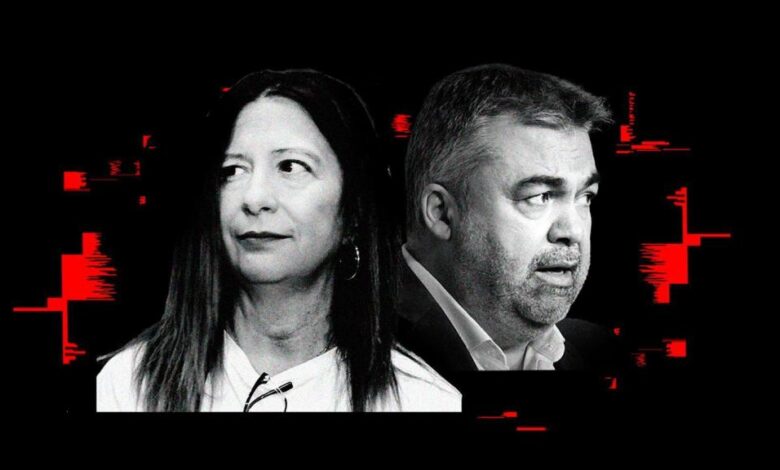
A new political and legal scandal is unfolding in Spain, one that may shape public perception of transparency within government institutions. A judicial investigation linked to the actions of Leire Díez, nicknamed the PSOE ‘fountain’, is escalating: the judge is considering summoning key party figures for questioning. The issue of who sought access to confidential anti-corruption files — and for what purpose — is increasingly pressing for the public.
Judge Arturo Zamarriego has requested the prosecution’s opinion on whether it is necessary to call Ion Antolín and Juanfran Serrano as witnesses. Antolín previously headed communications at PSOE, while Serrano served as deputy secretary for organization. Their potential testimonies could shed light on the details of a meeting held in April 2024 at the party’s central office on Ferraz street in Madrid.
The meeting on Ferraz
At that very meeting, in addition to Antolín and Serrano, Antonio Hernando, now responsible for telecommunications in the government, and Santos Cerdán, then the party’s secretary for organization, were present. At the gathering, Leire Díez handed over documents to the party leadership, including an audio recording mentioning Sabiniano Gómez, the father-in-law of Prime Minister Pedro Sánchez. In the recording, former commissioner José Manuel Villarejo claimed that Gómez allegedly managed establishments providing intimate services.
Immediately after this event, which coincided with the start of the investigation into Sánchez’s wife, the party and the government accused the so-called ‘patriotic police’ of attempting to discredit them. On Monday, the court heard testimony from Serdán and Hernando, who confirmed the meeting and the handover of the audio recording.
Pressure and accusations
Earlier, the civic organization Hazte Oír, acting as a public prosecutor, petitioned to summon Antolín and Serrano. The judge allowed the prosecution time to form a position on this matter. A decision regarding whether they need to be questioned will be made after a response is received.
Meanwhile, the judge admitted former judge Manuel García-Castellón as a private prosecutor, a name that surfaced in conversations involving Leire Díez. However, after objections by the prosecutor and Díez herself, García-Castellón’s status as a victim was revoked. His lawyer filed an appeal, arguing that Díez’s actions were intended to discredit the judge and damage his professional reputation.
Secret meetings
The appeal mentions a meeting between Leire Díez and prosecutor Ignacio Stampa, who secretly recorded the conversation due to suspicions about her intentions. Businessman Javier Pérez Dolset was also present and expressed the view that García-Castellón would not be able to retire peacefully. During the conversation, accusations were made against the judge regarding his professional activities and specific legal cases, which, according to the lawyer, amounted to an attempt to undermine his authority and influence the course of other proceedings.
García-Castellón previously led the investigation into the Villarejo case, in which the ex-commissioner himself and the PSOE are both involved. As part of this case, the party submitted the very recording about the saunas to the court, but a fragment that was not included in the official material appeared publicly: in it, Villarejo claims that Sánchez met with representatives of the ‘patriotic police’ after his father-in-law had lunch with them.
Split in the ranks
García-Castellón rejected the theory of a police conspiracy against the PSOE, pointing to ties between Enrique García Castaño, one of the ‘patriotic police’, and the prime minister’s father-in-law. In a September television interview, Leire Díez admitted that in 2017, Antonio Hernando and Óscar López, who at the time supported a faction competing with Sánchez, also tried to obtain compromising material about the ‘father-in-law’s saunas’ to use against the current prime minister.
This entire story once again raises questions about the methods of political struggle in Spain and how far certain individuals are willing to go to achieve their objectives. The legal proceedings are ongoing, and each new ruling could alter not only the course of the case but also the country’s political landscape.
In recent years, Spain has repeatedly faced high-profile investigations involving audio recordings, secret meetings, and attempts to discredit rivals. Such cases have often led to reconsideration of positions within parties and even the resignation of senior officials. Notably, in 2023, a leak of recordings involving Interior Ministry representatives triggered a wave of public distrust and prompted parliamentary hearings. Each of these incidents underscores the acute issue of transparency and government accountability in the country.