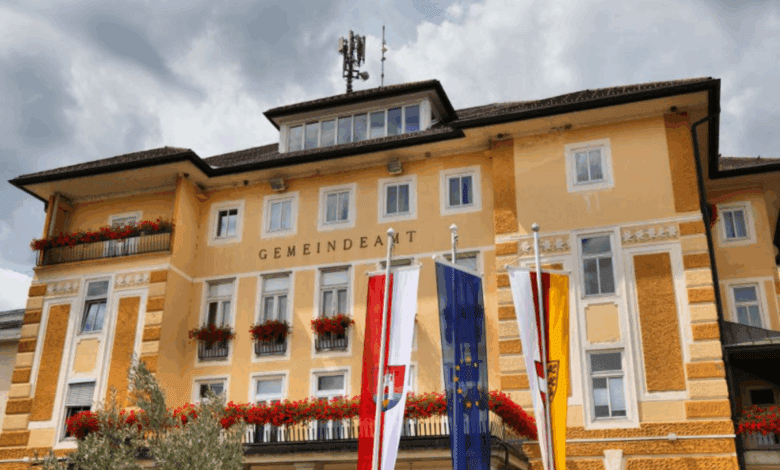
An incident worthy of an absurd comedy unfolded in a small Austrian village with a population of under a thousand. During scheduled renovations of the local administration building, it was discovered that, according to legal documents, the property does not belong to the municipality at all. The revelation was so unexpected that even seasoned officials struggled to believe what was happening.
Such a scenario is hard to imagine in Spain. Here, municipal buildings are always city property, and their status is enshrined in law. The country’s Constitution explicitly states that managing and owning such properties is the exclusive prerogative of local governments. But as it turns out, things can play out very differently in Austria.
An unexpected twist
It all started with a routine construction project. The municipality had decided to upgrade the facade and interiors of the building housing the administration. But while processing the paperwork for the renovation, questions arose over ownership rights. Checking the archive documents led to a surprising discovery: according to cadastral records, the official owner was not the town but instead a certain school community, an entity that has long since ceased to exist.
Documents dating back to the mid-19th century clearly state that the building belongs to the “Großriedenthal school district.” This district was dissolved many years ago, yet formally remains the owner. This situation has cast doubt not only on the legality of the ongoing works but also on the very possibility of using the building for its intended purpose.
Legal labyrinths
In Austria, transferring property ownership is a lengthy and rather complicated process. For the municipality to officially become the owner, it must gather a significant set of documents, go through notarization, and then secure amendments in the state registry. Without this, any actions involving the property may be deemed illegal.
As a result, the renovation work had to be suspended. Officials found themselves in a situation where even basic repairs like window replacements or roof updates required approval from a nonexistent authority. The question of who should now make decisions about the building remains unanswered. Locals, long accustomed to viewing the town hall as a symbol of the city, were genuinely surprised to learn it does not legally belong to them.
A Spanish contrast
For Spanish municipalities, such a situation seems unthinkable. Here, all assets related to city administration are strictly monitored and accounted for. The legislation leaves no loopholes for such incidents: ownership rights to administrative buildings are clearly defined and protected. Any changes are recorded in registries, and disputes are resolved quickly and transparently.
Nevertheless, the Austrian case clearly demonstrates how historical documents and bureaucratic nuances can unexpectedly intrude into the everyday life of even the smallest towns in Europe. Sometimes the past quite literally emerges from the archives and begins dictating new rules to the present.
Unanswered questions
While Großriedenthal is still dealing with the legal complexities, the fate of the building remains uncertain. The municipality must undergo a lengthy process of reclaiming ownership rights to regain control over its own property. Meanwhile, renovation work is on hold and residents are debating how such a situation could happen in the 21st century.
This case is a reminder that even in the most stable and well-organized countries of Europe, situations can arise that call the established order into question. Sometimes, a single forgotten entry in the archives is enough for the entire system to fail. And then, even a small town becomes an arena for major legal battles.