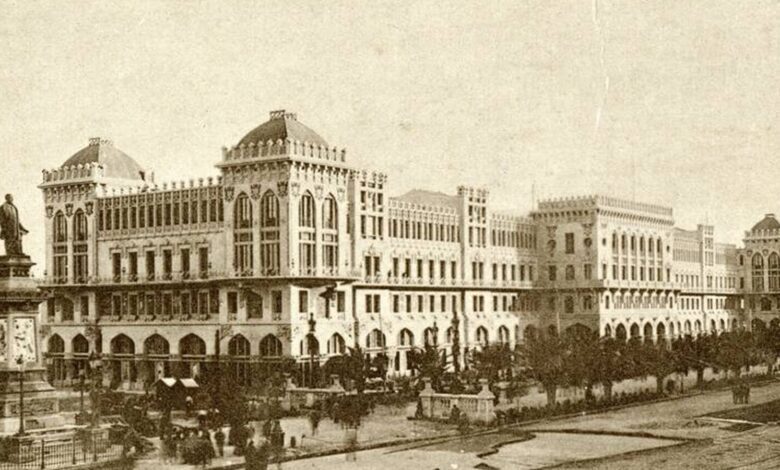
In 1888, Barcelona became the stage for the World Exhibition, and the city sought to demonstrate its modernity and ambition. To welcome guests and delegations, it was decided to build a grand hotel that would not only serve as temporary accommodation, but also as an architectural symbol of a new era.
The project was entrusted to the architect Lluís Domènech i Montaner, who took on the task at unprecedented speed. Construction began in December 1887, and after just 53 days, the building was almost finished. In just 83 days, more than 400 workers labored around the clock to be ready in time for the opening of the exhibition. Temporary workshops were set up at the construction site, where decorative elements and structures were manufactured on the spot. Work continued even at night—electric lighting made it possible to maintain the pace.
The grand hotel was built on a site between today’s Drassanes and Barceloneta neighborhoods, near the port. This provided convenient access for guests arriving by sea. The building occupied more than 5,000 square meters, and its six-story façade immediately attracted attention with its modern appearance, anticipating the Art Nouveau style.
The structure was built using wood and iron, which sped up construction and reduced costs. The facades were covered with plaster imitating stone and adorned with geometric and floral motifs. Inside, there were 600 rooms, a spacious restaurant seating a thousand guests, meeting halls, lobbies, and terraces overlooking the sea. Lighting was provided by both gas and electricity—a technical innovation for that time.
The hotel quickly became a center of Barcelona’s social life. Notable figures, entrepreneurs, and journalists stayed there, and its interiors and facades often appeared on postcards and in European newspapers. The building gained fame far beyond Spain, becoming a symbol of technical progress and architectural audacity.
However, the fate of the hotel was predetermined from the start. It was built as a temporary structure, intended only for the duration of the exhibition. After the event ended, various options were considered, such as preserving or relocating the building, but economic calculations showed this was not feasible. On May 1, 1889, just over a year after its opening, the hotel began to be dismantled. All the materials were sold for reuse, and soon no trace remained of the once grand structure.
Today, the port area of Barcelona looks completely different. The site where the hotel once stood has been entirely transformed following major 20th-century renovations and preparations for the Olympic Games. All that remains of the former giant are photographs, archival documents, and memories of contemporaries. The story of the Grand Hotel is a reminder that the drive for innovation and the desire to impress the world can give rise not only to great achievements, but also to vanishing symbols of an era.