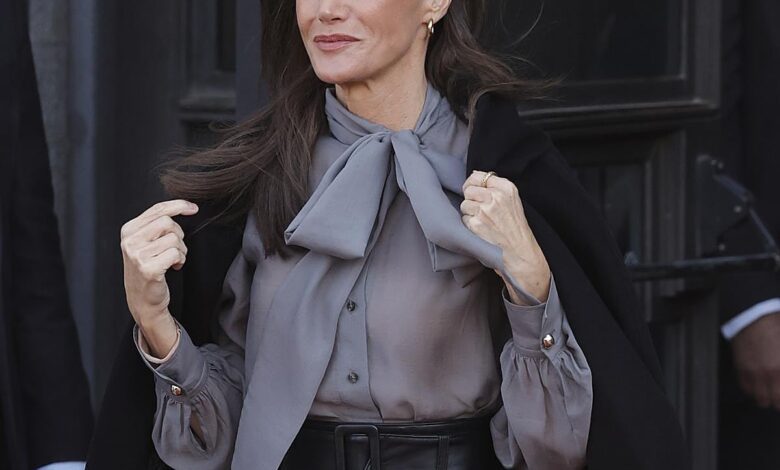
A lavish banquet took place at the El Pardo palace in Madrid, bringing together the Spanish royal family and their Greek relatives under one roof. The official reason for this large-scale event, which gathered more than sixty guests, was the celebration of the 50th anniversary of the restoration of the monarchy in Spain. However, behind the façade of festivity, there was palpable tension, the main cause of which was the presence of honorary king Juan Carlos.
Source of tension: the honorary king’s visit
The public appearance of Juan Carlos I, whose name has been closely linked to scandals in recent years, became the highlight of the day. Many observers assumed that the extensive guest list was intended to somewhat ‘dilute’ his controversial presence in the crowd. The honorary king was the first to arrive in Madrid, around one in the afternoon, coming directly from Abu Dhabi, where he resides permanently.
His visit to his homeland was lightning-fast and lasted only six hours. According to reports, he once again requested permission to stay overnight at the Zarzuela palace but was refused. Staying true to his unspoken rule to never stay anywhere in Madrid except his former residence, Juan Carlos left El Pardo immediately after the banquet and headed straight back to the airport to fly to the Emirates.
A parade of guests and a royal menu
After the honorary king arrived, other family members began to gather at the palace. Queen Sofía arrived in the same car as Infanta Cristina. They were followed by the Urdangarin brothers, Pablo and Miguel, accompanied by their partners. The Greek branch was represented by the widow of King Constantine II, Anne-Marie, her son, the head of the Greek Royal House Pavlos, together with his wife Marie-Chantal Miller. Infanta Elena arrived with her daughter, Victoria Federica, and her brother Froilán was behind the wheel.
Among the guests spotted were Princess Alexia with her husband Carlos Morales, who flew in from Lanzarote, Prince Nikolaos of Greece with his wife, Princess Theodora with her spouse, and Prince Philippos with his wife. The hosts of the event—King Felipe VI and Queen Letizia, accompanied by their daughters, Princess Leonor and Infanta Sofía—were the last to arrive, shortly before two in the afternoon.
The lunch itself, organized by the Alabardero catering service, lasted about four hours. Guests were served porcini mushrooms as a starter and sea bass for the main course. After the meal, the gathering continued over coffee in an informal setting.
Behind closed doors: a toast and new alliances
The event was private, so no official statements were made about what took place inside. However, some details leaked to the press. It became known that King Felipe VI took the microphone and delivered a heartfelt toast. In his speech, he acknowledged the achievements of both parents, expressing his gratitude to both Queen Sofía and King Juan Carlos.
Queen Letizia, according to eyewitnesses, stayed close to her daughters at all times. Notably, she did not invite any of her relatives from the Ortiz Rocasolano family to this challenging family gathering, despite the support they could have offered. This has sparked a new wave of rumors about an unexpected alliance. Observers note a clear rapprochement between Queen Letizia and Queen Sofía. Both women are believed to have been hurt by the honorary king’s recent memoirs, which may have united them against a ‘common adversary.’
Notably, Juan Carlos I de Borbón is one of the most controversial figures in Spain’s recent history. He ascended the throne in 1975 after the death of dictator Francisco Franco and played a pivotal role in the country’s transition to democracy, earning enormous respect both at home and abroad. His decisive actions during the attempted coup in 1981 bolstered his authority and safeguarded Spain’s fledgling democracy. However, the final years of his reign and the period following his abdication were marred by a series of high-profile scandals. Corruption allegations tied to his finances and deals with Saudi Arabia dealt a major blow to the monarchy’s reputation. Public outrage also followed his expensive elephant hunting trip to Botswana during Spain’s economic crisis. Under mounting public pressure and facing deteriorating health, Juan Carlos I abdicated in favor of his son Felipe in 2014. In 2020, seeking to protect the crown’s image, he left Spain and has lived in Abu Dhabi since, making only brief and infrequent trips back home.