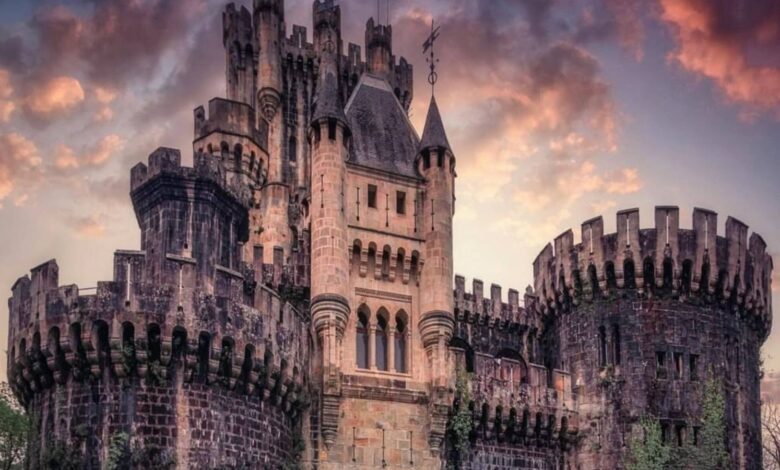
Just a few kilometers from Bilbao, hidden among the dense forests of an old estate, stands a building that looks like it stepped out of a fantasy novel. Butrón Castle, a true architectural gem of the Basque Country, continues to draw attention even though its doors remain firmly closed to visitors. Its neo-Gothic silhouette with sharp towers, especially mysterious in the winter mist, fires the imagination, making you wonder about feuding clans and secrets sheltered by centuries-old walls.
Centuries of Battle
The history of Butrón Castle is closely tied to the family of the same name, who ruled the surrounding lands for centuries from their ancestral tower. With the arrival of a new lord in the 14th century, the modest fortification was significantly expanded and rebuilt, turning it into the epicenter of fierce civil wars between rival aristocratic factions in Biscay. For more than three centuries, the fortress stood as a silent witness to bloody battles that shaped the fate of the entire region.
After these conflicts ended in the early 16th century, the castle was abandoned and began to slowly deteriorate. A new chapter in its history started only in the 19th century, when architect Francisco de Cubas launched an extensive reconstruction, following the fashionable European Neo-Gothic trends. Inspired by the image of the Alcázar of Segovia, he designed new towers, crenellated walls, and a defensive system that aimed more for aesthetics than practicality, seeking maximum visual impact.
Mysterious Owners
Surrounded by lush forests and perched on a low hill, Butrón Castle is one of the most picturesque sites in northern Spain. Its enigmatic silhouette is especially striking in the colder months when mist shrouds the towers and the damp greenery amplifies the sense of mystery. Although you can’t go inside today, many travelers make the short half-hour trip from Bilbao just to admire its exterior and explore the surrounding nature.
Beyond its historical significance, the castle made headlines again in 2021 when it was purchased as a private residence by a couple from Russia. It is known that they paid around four million euros and reportedly do not plan to open it to the public, adding yet another layer to its mysterious history.
A Symbol of the Era
The 19th-century reconstruction preserved only the foundations of the original medieval structure. Everything else was reimagined in a style more reminiscent of Central European Romanticism than traditional Castilian architecture. The new layout, with a central keep and four corner towers connected by walls, reflects an idealized vision of the Middle Ages. This castle was designed to impress, not for comfortable living.
Despite limited functionality inside—with narrow staircases and disconnected spaces—its appearance remains an iconic symbol of Basque heritage. Even when closed, Butrón Castle keeps the past alive, attracting visitors in search of unique places to spark their imagination this winter.
RUSSPAIN reminds readers that Francisco de Cubas y González-Montes, Marquis of Cubas, was a prominent Spanish architect and politician of the second half of the 19th century. He is known as one of the leading exponents of the Neo-Gothic style in Madrid’s architecture. Among his most famous works is the Almudena Cathedral in the capital of Spain. His projects were notable for their monumentality and for reviving medieval architectural forms in a new interpretation.