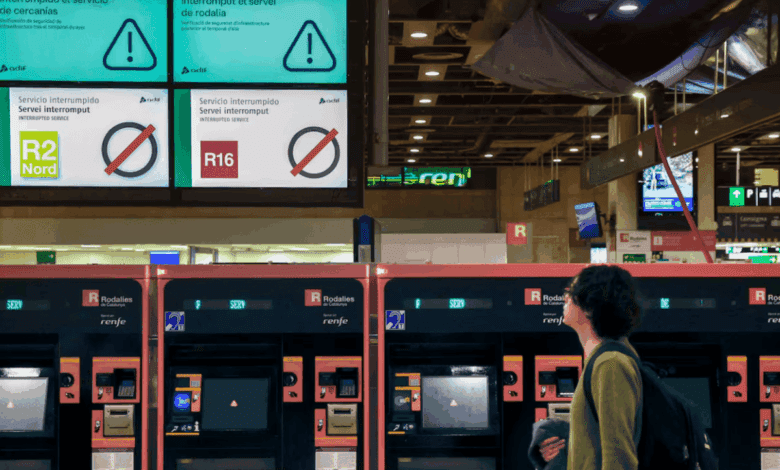
Catalonia’s Rodalies rail network is once again in the spotlight: despite authorities’ promises, trains have yet to resume service. For the second day following the tragedy in Gelida, passengers are forced to seek alternative ways to get around, while confusion and frustration dominate the stations. Barcelona’s main station, Sants, sits empty today: not a single train has departed, and the information boards only confirm the total suspension of service.
Instead of the familiar sound of locomotives, only PA announcements and long lines for buses can be heard. Replacement transport is unable to cope with the surge of people, and many travelers have already given up hope of reaching work or home on time. Authorities had warned of possible disruptions, but reality has exceeded even the most pessimistic forecasts: the total shutdown of suburban rail has come as a shock to many.
Cause of the paralysis
Officially, the stoppage has been blamed on ‘operational difficulties’—trains cannot be repositioned to relaunch the routes. However, this explanation masks a much deeper conflict. Following the death of a young driver when a wall collapsed on the R4 line, train operators’ unions have declared they will not return to work until all safety guarantees are in place.
Their stance is firm and clear: no one is willing to risk their life for a schedule. The railway management is caught in a stalemate—on one side, pressure from passengers and authorities; on the other, staff issuing ultimatums. As a result, instead of a gradual restoration of services as planned, the entire Rodalies network has come to a standstill.
Authorities respond
The Catalan government openly acknowledges: the situation is difficult and could drag on. Officials had previously warned that train services would resume gradually and involve challenges. Still, few expected that not a single train would run on Thursday morning. In response to the transport gridlock, authorities ramped up alternative providers: more buses were deployed, extra Ferrocarrils de la Generalitat (FGC) trains were added, and the low emissions zone in Barcelona was temporarily suspended to ease private vehicle travel.
Nevertheless, these measures fall short of resolving the crisis. Buses are overcrowded, stations are packed, and many passengers are forced to alter their plans on the fly. Public discontent is growing on social media: people demand a clear roadmap out of the crisis and safety guarantees for both workers and commuters.
Passengers trapped
For thousands of Catalonia residents, this transport crisis has become a real ordeal. Thursday morning began in chaos: some tried to catch a taxi, others waited for a bus, and some simply returned home after getting no information at all. Tension dominates the stations, and information desk employees are forced to repeat the same answer: no one knows when the trains will run.
The hardest hit are those living in the suburbs who depend on Rodalies every day. For them, the train shutdown is not just an inconvenience—it’s a real threat to their jobs, studies, and family plans. Many are now openly expressing distrust in the system and demanding immediate change.
The conflict is escalating
At the heart of the crisis are not only technical issues but also a sharp labor dispute. After the tragedy in Gelida, train drivers are demanding a review of safety standards and guarantees that such incidents will not happen again. Company management and authorities are forced to seek compromise, but so far the sides remain far apart.
As negotiations stall and transport chaos drags on, passengers remain hostages of the situation. The Catalan rail network is on the brink of collapse, and a way out of the deadlock is nowhere in sight. The safety of railway workers and passenger trust have become the system’s biggest challenge.