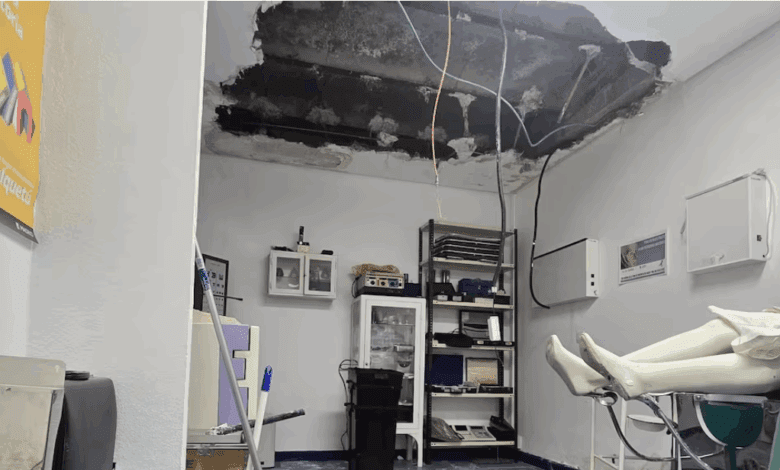
On Monday evening in Vallecas, municipal health center staff were startled by a loud crash and alarm. In one of the rooms on the second floor, the suspended ceiling suddenly collapsed. Fortunately, the room was empty at the time—no one was injured. Still, the incident serves as another reminder of the state of much of Madrid’s urban infrastructure.
The building where the incident occurred was constructed back in 1965. It originally served as a hospital for the underprivileged, and since 2005 has been managed by the municipal health service. Over the decades, the walls and roof have undergone multiple renovations, yet, as it turns out, the problems have persisted.
Warning signs
On the day of the incident, staff had already noticed troubling signs: after recent rains, water had seeped into several offices, damaging equipment and documents. Damp patches appeared on the first-floor ceiling, and upstairs—the room where the collapse happened—had been closed off after earlier leaks. But even these measures couldn’t prevent the accident.
When the crash sounded in the evening, only a handful of medical workers were in the building. They immediately realized the situation was spiraling out of control. The very next day, a concerned manager was seen walking the corridors, discussing over the phone that classes on the first floor would have to be suspended until safety could be guaranteed.
A chronicle of neglect
Problems with this building are nothing new. In 2018, it received an unsatisfactory rating following a technical inspection: the facades, roof, and utilities all needed repairs. Although some defects were formally addressed, staff say that leaks and dampness have only worsened since the pandemic. Damp patches on the ceilings have become a familiar part of the interior.
Municipal services, it seems, are in no rush to tackle the issue fundamentally. Center employees report that in winter, they can go months without heating, and in summer, rely on portable air conditioners to cope with the heat. Living with constant discomfort has become their new normal.
A systemic issue
The situation with this center is not an exception, but rather the rule in Madrid. More than half of the preschools and nearly half of the schools in the capital received unsatisfactory results in technical inspections. Despite this, educational institutions continue operating and children keep attending classes. Responsibility for the state of the buildings remains blurred between the municipal and regional authorities, who shift the blame onto each other.
The question of who should handle repairs and ensure safety remains unanswered. Meanwhile, residents of southern Madrid increasingly feel like second-class citizens. Their infrastructure keeps deteriorating, and government attention to these issues is minimal.
The voice of the street
Irritation is growing among the center’s staff and local residents. Union representatives openly speak of chronic underfunding and official indifference. According to them, working in such conditions means getting used to constant danger and everyday inconveniences.
Local politicians are also taking notice. Opposition members accuse the city administration of neglecting the southern districts. They believe incidents like this are a direct result of the uneven distribution of resources and attention across the city. Their rhetoric is pointed: the capital’s authorities are deliberately ignoring the needs of Vallecas and similar neighborhoods.
No response
At the time of publication, officials from the municipal security and health services had not commented on the incident. The center’s management and staff continue to work as usual, although some areas are now closed to visitors.
The story of the ceiling collapse at the municipal health center is just the tip of the iceberg. It clearly shows the consequences of chronic underfunding and the lack of a systematic approach to urban infrastructure maintenance. While authorities argue over jurisdiction, residents are forced to live with risks and inconveniences that have become part of daily life.