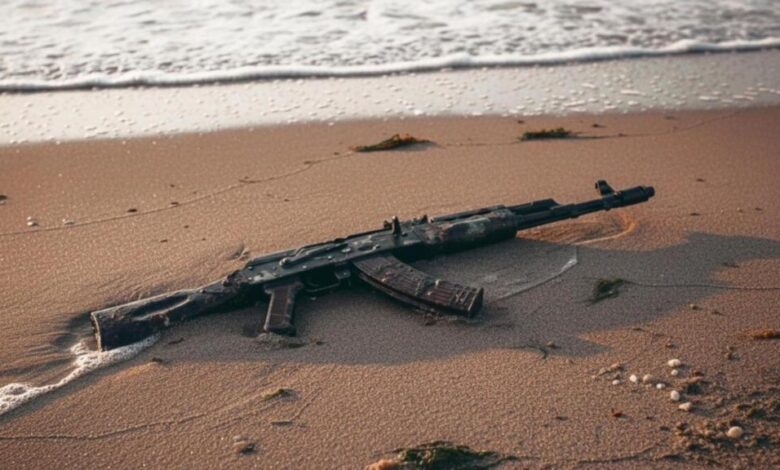
In October, two vacationers made an unusual discovery on Playa Estudiantes in Villajoyosa. In the water, among coastal rocks, they spotted a strange object. When they pulled it ashore, they realized they were holding a dismantled and rust-covered Kalashnikov rifle with two loaded magazines.
Immediately after the discovery, the vacationers contacted the local police. Officers from the Guardia Civil arrived at the scene, confiscated the weapon and ammunition, and launched an investigation. Ballistics experts are now trying to determine how the rifle ended up on the beach — whether it was used in a crime or belonged to one of the criminal groups operating in the region. According to specialists, such investigations often take time due to the challenges of tracing illegal firearms.
How illegal firearms enter Spain
In Spain, it is illegal for civilians to possess a Kalashnikov rifle. This weapon is classified as strictly military and is known for its high firepower. Despite the ban, criminals regularly get their hands on these rifles. Most are trafficked through the Balkans: Serbia, Croatia, Bosnia and Herzegovina, and Albania. These countries have become key suppliers for Europe’s black market.
Besides the Balkans, weapons also come from conflict zones such as the Sahel, Ukraine, and the Middle East. Smugglers transport automatic rifles hidden in RVs, trucks with double floors, or concealed among legitimate cargo. In 2025, the Civil Guard intercepted an RV carrying 25 AK-47 rifles, an MG-42 machine gun, more than a hundred grenades, and a large batch of ammunition. The weapons were en route from Bosnia and Herzegovina to France. In the Balkans, an assault rifle can be bought for about 300 euros, while in Spain the price rises to 1,000–2,000 euros for a working piece.
Criminal gangs arming up
Over the past year, Spain has seen a significant increase in the number of military-grade assault rifles found among drug traffickers and other criminal groups. The problem is particularly acute in certain areas of the Alicante province, where authorities report a rise in weapons seizures.
The Marina Baixa area on the Costa Blanca is considered a hotspot for organized crime. The region is home to fugitives, drug traffickers, and former military personnel from Eastern Europe. During clashes and attacks, criminals are increasingly turning to automatic weapons, putting both local residents and police officers at risk.
Police protection under threat: new challenges
Local police officers find themselves unprepared to confront armed gangs. Currently, only the Guardia Civil has the authority to use long-barreled firearms, while municipal units are restricted in their armament. Because of this, police leaders are urging lawmakers to revise the regulations so officers can access more powerful weapons to protect themselves and the public.
The discovery of an assault rifle on the beach in Villajoyosa has become yet another troubling signal for the region. Authorities are continuing their investigation to determine how military-grade weapons ended up on the coast and to prevent similar incidents in the future.