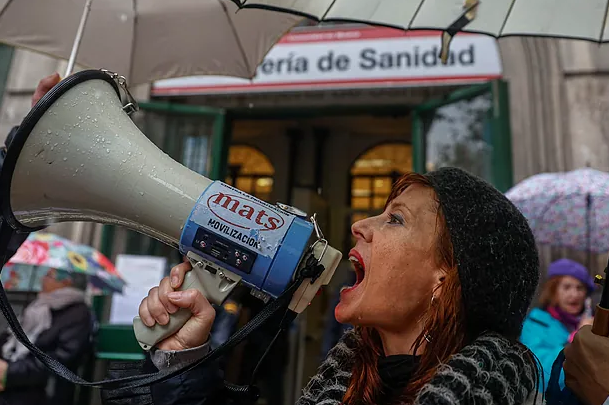
A large-scale doctors’ strike began across Spain today, set to last for four consecutive days. Medical professionals from various regions are protesting the Ministry of Health’s proposed unified statute for all healthcare staff, insisting on a separate document that would address the specific nature of their profession. This is the third such demonstration in the past six months, and judging by the resolve of the participants, they have no intention of backing down.
The strike is organized by the Confederation of Medical Trade Unions (CESM) and the Andalusian Medical Union (SMA), who emphasize that doctors deserve more than just a separate chapter in a general law. They argue that the current proposal fails to reflect the real needs and unique aspects of medical professionals’ work and does not guarantee proper working conditions.
Disagreements among unions
Interestingly, not all unions support the doctors’ demands. Major groups such as UGT, CCOO, CSIF, SATSE-FSES, and CIG-Saúde, on the contrary, oppose granting a separate status to medical workers. They believe such a move would undermine the unity of the system and create inequality among staff. Moreover, these organizations have already announced an indefinite strike for January, but with the opposite demands—they insist on preserving the general law for all healthcare employees.
The Ministry of Health, in turn, is calling for collective responsibility and urges not to block a reform that, according to them, could be historic. The ministry emphasizes that the draft law was developed taking into account the opinions of all parties, incorporating key proposals that do not contradict the Constitution or the powers of the autonomous communities. However, many of the doctors’ demands, in the ministry’s view, exceed their authority or violate legislation.
Changes in working conditions
Among the measures proposed by the ministry are mandatory job competitions every two years, reducing the maximum shift duration from 24 to 17 hours, limiting the number of weekly shifts, and recognizing mandatory rest periods after night shifts. According to officials, all these measures should increase stability and quality of work within the healthcare system.
However, representatives from CESM and SMA believe these changes do not go far enough. Once again, they have called on colleagues across the country to take to the streets and voice their dissatisfaction. Each regional union will independently decide how to participate: in some places, protests will last the full four days, while in others they may be limited to one or two days, and in certain regions, only a symbolic demonstration is planned.
Protests in Madrid and Barcelona
In Madrid, the Association of Doctors and Senior Specialists (Amyts) is organizing a large march from the Congress to the Ministry of Health building. The main goal is to secure a special status for doctors and remind local authorities of unresolved issues, such as salary increases and aligning working conditions at Hospital Gómez Ulla with the standards of the regional healthcare system (Sermas).
In Barcelona, the Metges de Catalunya union has planned two major demonstrations. The first kicks off this morning at the government delegation building and will end at Plaça de Sant Jaume, while the second, on Wednesday, will march from the Faculty of Medicine at the University of Barcelona to the health department of the Generalitat de Catalunya. Hundreds of healthcare workers are expected to join the protests.
Reaction and prospects
It remains unclear whether these protests will lead to a change in the position of the ministry or other unions. Doctors insist on continuing the dialogue and are prepared for further action if their demands go unheard. Authorities, meanwhile, stress that further delays to the reform could mean missing a unique opportunity to update outdated legislation that has remained unchanged for the past twenty years.
In case you didn’t know, the Confederation of Medical Unions (CESM) is the largest association of doctors in Spain, advocating for healthcare professionals at the national level. Sindicato Médico Andaluz (SMA) is active in Andalusia and often leads regional protests. Amyts is the leading doctors’ organization in Madrid, while Metges de Catalunya is the main medical union in Catalonia. All of them play a crucial role in shaping healthcare policy and defending doctors’ rights in Spain.