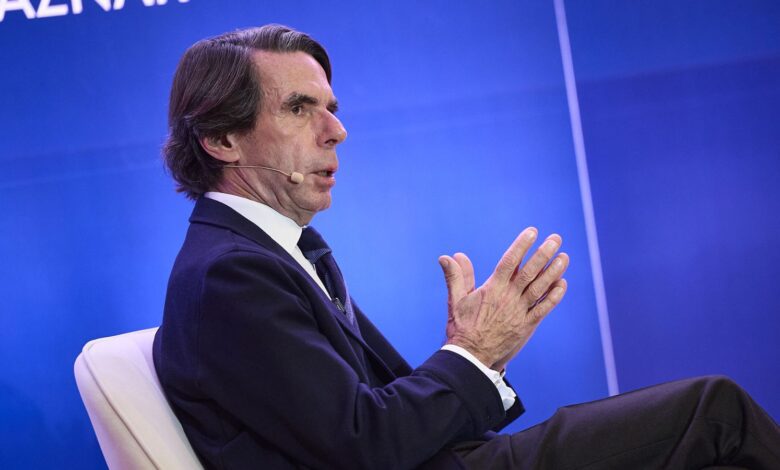
The scandal surrounding the public statements of Spain’s Minister of Foreign Affairs has reached a new level, impacting not only the political elite but also the country’s international reputation. The intervention by the FAES foundation, associated with former Prime Minister José María Aznar, signaled that Spain’s political disagreements could escalate into legal battles with unpredictable consequences for all involved.
FAES sharply criticized Foreign Minister José Manuel Albares, accusing him of abusing parliamentary immunity and spreading defamatory insinuations linking Aznar to the Jeffrey Epstein case. The foundation emphasized that such statements, made from the parliamentary podium, could lead to legal proceedings if the minister continues to associate the former premier with the crimes of the American financier.
During recent debates in the Senate and Congress, Albares recalled that Aznar’s name appeared in the so-called ‘Epstein documents.’ He made this comment in response to opposition accusations concerning former president José Luis Rodríguez Zapatero’s connections with Huawei and Plus Ultra. The minister stressed that he did not intend to press charges, but mentioned the fact that Aznar’s name surfaced in case materials, which provoked a strong reaction from FAES.
In its statement, the foundation noted that if anyone believes the mention of two email records is enough to suspect concealment or the commissioning of illegal actions, such accusations should be made openly and explicitly, without innuendo. FAES also remarked ironically that if such claims come from someone with immunity, this could be grounds to consider lifting parliamentary protection in Spain.
FAES response
FAES did not stop at accusations against Albares. The foundation sharply criticized his foreign policy, calling it “podium diplomacy,” and accused the minister of confusing diplomats with support staff. According to FAES, the Foreign Minister applies international law selectively, using different standards for the conflicts in Gaza and Western Sahara.
The foundation’s statement also claimed that Albares’s policies have led to a record decline in Spain’s international standing. FAES asserts that the country has reached “zero external relevance” and accuses the minister of hiding behind parliamentary immunity to make unsubstantiated insinuations.
In response to opposition questions regarding the Epstein case, FAES stated that using such topics in political debate is an attempt to drag the discussion into petty exchanges that have nothing to do with the country’s real issues.
Political context
The situation surrounding Albares’ statements and FAES’s response reflects a general rise in tensions between the government and the opposition. In recent months, political debates in Spain have increasingly been marked by mutual accusations and public scandals, negatively impacting trust in the country’s institutions.
Such conflicts are not uncommon in Spanish politics. Recently, in the spotlight was a heated controversy between journalists and Elon Musk regarding statements about Pedro Sánchez, which also sparked widespread public reaction and debate about the boundaries of acceptable conduct in public discussions.
As political rivals more frequently resort to personal attacks and insinuations, such incidents become subjects of discussion not only within the country but also abroad. This affects Spain’s image and could influence its position in international negotiations.
Context and consequences
In recent years, Spain has seen more cases where political debates escalate into public scandals involving threats of legal action. This is especially common against the backdrop of high-profile international affairs affecting the reputation of prominent figures. Such situations have already led to prolonged conflicts between authorities and the opposition, as well as growing public distrust.
A surge of mutual accusations and personal attacks in parliamentary debates has become a hallmark of modern Spanish politics. This affects not only domestic stability but also the country’s image abroad. In such cases, public and media attention is invariably drawn to the details, and the consequences can be felt long after the debates themselves have ended.