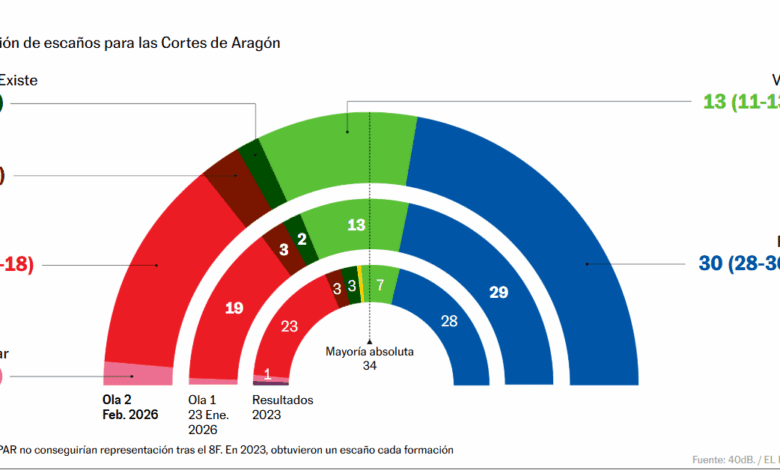
The results of a recent poll in Aragon have sent an alarming signal to everyone monitoring Spain’s political landscape. Just a week before the regional elections, the Socialists are on the brink of a historic failure: their support is falling while competitors are gaining ground. This could have serious consequences for the balance of power in the region and affect the future distribution of authority.
According to the latest data, the Partido Popular (PP) is steadily increasing its presence in the Aragonese parliament. The party is projected to secure 30 seats—two more than in the previous election—coming within just four of an absolute majority. This growth indicates that voters are searching for new solutions and are not afraid to change their preferences.
Socialists under pressure
For the Socialists (PSOE), the situation looks extremely unfavorable. If the forecasts come true, the party will lose two more seats, dropping to 17 deputies. This would mark their worst result in Aragonese electoral history, surpassing the anti-record of 2015 when the Socialists won 18 seats. The decline in support is especially noticeable given that, over the past week, the proportion of undecided voters among PSOE supporters has dropped by nearly four points, but not to the party’s benefit.
Meanwhile, Vox is holding its ground and even strengthening its influence. Estimates suggest the party could win 13 seats—almost double its previous tally. This confirms the trend of growing support for right-wing forces in the region and complicates the process of forming a future coalition.
Fragmentation on the Left
The left flank of the political spectrum in Aragón remains fragmented. Various parties and coalitions — Chunta Aragonesista (CHA), IU-Sumar, Podemos-Alianza Verde, as well as the regionalists Aragón Existe and Partido Aragonés (PAR) — are competing for the same voters. IU-Sumar is seeing the most growth and could secure two seats, one more than in the previous poll. The rest, including Podemos and PAR, risk being left out of parliament.
Such fragmentation on the left benefits larger parties and makes it harder to form stable alliances. With every vote counting, even slight shifts in support can lead to unexpected outcomes in the final distribution of seats.
Shifts in the Electorate
Polls show that the electorate is becoming increasingly unpredictable. In a short period, voter preferences can shift under the influence of external events as well as the course of the campaign itself. Recent weeks have featured not only political debates but also high-profile incidents that could have swayed public opinion.
As a result, traditional parties are losing part of their base, while new contenders and alternative coalitions have a chance to make their mark. This creates an atmosphere of uncertainty and fuels interest in the election outcome.
Context and Implications
The situation in Aragon reflects broader trends observed in other regions of Spain. In recent years, the country’s political landscape has become increasingly fragmented, with voters shifting their allegiances more frequently. Similar scenarios have already unfolded in Extremadura and Castilla y León, where traditional parties also faced unexpected losses and the rise of new forces.
In 2023, similar changes occurred in Galicia, where the growing support for right-wing parties led to a review of coalition agreements. In Catalonia and Valencia, there has also been a rise of regionalist and alternative movements in recent years, complicating the formation of stable governments. These examples show that Spain’s political dynamics are becoming less predictable, with election outcomes increasingly dependent on short-term factors and public sentiment.