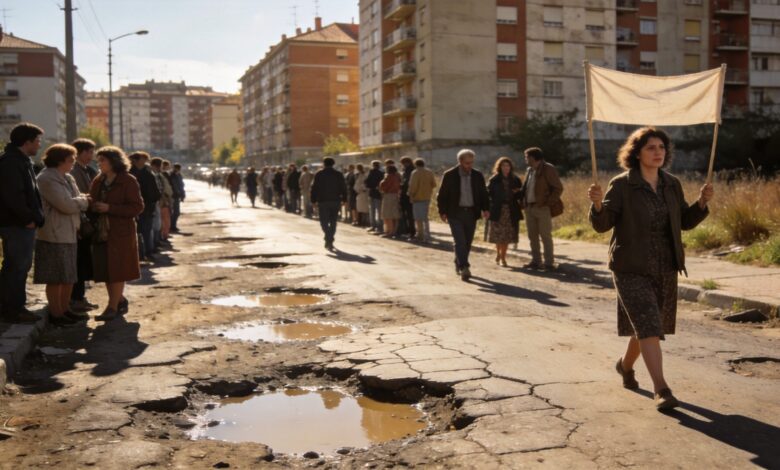
In March 1976, an event took place in Madrid that became significant for all of Spain: for the first time since Franco’s death, the authorities officially permitted a street demonstration. For the residents of Canillas, this was not just an opportunity to openly express their discontent, but also the start of a new relationship between society and the state. The protest focused on the condition of the roads, but its impact went far beyond a single street.
At that time, Canillas was a district on the outskirts of the capital, where infrastructure lagged behind rapid population growth. Roads were in disrepair, public transportation was unreliable, and new residential blocks appeared faster than schools and shops. According to El Pais, these problems pushed the local community to organize what became the first officially sanctioned demonstration in Madrid after the dictatorship.
Organization and support
The Housewives Association Esperanza, led by activist Marta Hidalgo, played a key role in organizing the protest. Despite the risks, she filed a request for the demonstration with the authorities. Other residents of the district also took part in the preparations, and legal support was provided by the well-known lawyer Luis Javier Benavides. To draw attention to the issue, a striking slogan was created—“Carretera de Canillas, 200 baches por milla,” coined by the famous artist Forges. According to El Pais, this slogan quickly became a symbol of the struggle for the rights of those living on the outskirts.
Authorities unexpectedly approved the application, setting a precedent at the time. The Governor of Madrid, Juan José Rosón—who later became Interior Minister—personally congratulated the organizers on holding an incident-free event. This decision sent a signal to other districts in the capital: now, street protests could be held legally, provided certain conditions were met.
The day of the demonstration
On March 13, 1976, several hundred residents of Canillas took to the streets, marching along a broken road to draw attention to their problems. Along the route, demonstrators had to navigate not only potholes but also a police presence overseeing order. Despite the tension, there were no serious conflicts. Organizers had arranged with local authorities in advance to avoid provocations, and even members of the administration participated in ensuring safety.
At the end of the march, participants voiced their demands: to improve roads, establish better transport, and build schools and a metro. These issues were important for many areas of Madrid, and the success of the Canillas protest became a model for similar initiatives. As El Pais notes, after this case, such events were approved more often in the capital, accelerating the development of civil society.
Impact on urban movements
The protest in Canillas became a catalyst for increased activity among neighborhood associations across Spain. In the following years, numerous initiatives appeared in Madrid and other cities aimed at addressing local issues through collective action. The success of the first authorized demonstration showed that dialogue with authorities is possible and that legal forms of protest can be effective.
This experience also influenced legislation: requirements for public events became more transparent, and citizen participation in city life increased noticeably. According to El Pais, such actions laid the groundwork for future reforms in urban governance and public oversight.
Historical context
During the 1970s, Spain underwent profound changes. After Franco’s death, the country gradually transitioned to democracy, and street protests became one of the tools for pressuring the authorities. In Madrid and other major cities, such demonstrations often served as a catalyst for changes in urban policy. In recent years, the capital has repeatedly seen mass protests related to transport, infrastructure, and social issues. Each of these episodes marked a new stage in the development of civil society and in strengthening the dialogue between residents and local administration.