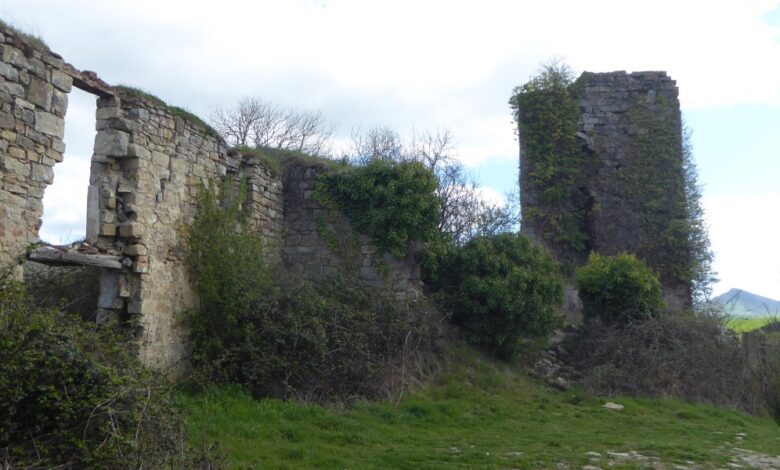
In the northern region of Spain, Navarre, time seems to have stood still in dozens of settlements. Once bustling with life, today they are nothing but ruins, overgrown with wild vegetation. The mass migration of people to cities in the mid-20th century, driven by socio-economic changes, left behind deserted streets and empty homes. Visiting these places is more than just exploring ruins—it’s a journey through history, an opportunity to touch the past and witness unique landscapes where nature is reclaiming its space from civilization. Here are eight such abandoned corners, each with its own unique story.
Ghosts of Valleys and Riverbanks
Hidden deep in the heart of the Isagaondoa valley lies Beroiz, a former feudal estate. Getting here today is no easy feat. The paths people once walked have all but disappeared under dense thickets. In its heyday, the village had only two residential houses and a church dedicated to Saint Martin. Some of these structures are still resisting the passage of time. The last residents left Beroiz in the 1960s, following the example of neighbors from other nearby villages.
On the banks of the Irati River, hidden from prying eyes by thick foliage, lies Larrangos—one of Navarra’s most unusual abandoned places. The path begins at the foot of the historic Aians Tower, a 14th-century defensive structure. To reach the village itself, part of the Longida municipality, visitors must navigate a narrow, challenging road. Those who dare embark on this small adventure will discover the remains of a settlement that, even in decay, has not lost its original charm.
Another iconic spot in the Isagaondoa Valley is Mendinueta, an important estate during the Middle Ages. The most remarkable of the remaining ruins are the 16th-century lordly tower and several old mansions that still peek through the lush vegetation. The wave of depopulation in the 1960s did not spare this place either, leading to its complete abandonment. The ruins, now surrounded by forest, silently preserve memories of former grandeur.
At the foot of Peña-Isaga mountain, in the same valley as Beroiz, lies Urbicain. It was abandoned in the 1970s, when its inhabitants left in search of work and those who remained grew old. Despite decades of neglect, several well-preserved buildings can still be found here: the Church of San Esteban and the former abbey, along with iconic houses such as Casa Melchor, Casa Pedros, and Casa Icurgui, all retaining the memory of their former owners.
Cheese kings and private estates
Perched atop a massive rocky outcrop in the Sangüesa region, Peña stands out among other abandoned villages. Its history is closely tied to the production of goat cheese, which once brought it fame. The exodus of residents began in the 1950s for a simple reason: the land belonged to a single family, and the tenants’ leases simply expired. Today, you can still see its iconic landmarks—the San Martín de Tous church and abbey, as well as the ruins of an ancient castle and an old fountain.
In the municipality of Romanzado, along a bend of the Salazar River, you’ll find Adansa. This village in the merindad of Sangüesa—the region where most such places are concentrated—gradually emptied out over the course of the 20th century. Like many others, its residents left in search of a better life. Today, its lonely streets are home to the shells of several houses and the 13th-century Church of Saint John the Baptist, which still towers nearby. It’s important to note that the entire area is now private property.
The last keepers of tradition
Mugeta is an abandoned village in the Longida valley, located near the gorge of the same name. Difficult access and a lack of basic amenities forced the last inhabitants to leave in the 1970s. Today, pushing through the undergrowth, you can spot the ruins of the San Martín de Tour church, an old abbey, and two houses that have survived better than the rest: Casa del Obispo (the Bishop’s House) and Casa Goñi.
Orradre is a tiny village in the municipality of Romanzado, near the Arbaiun Gorge. Life here came to a standstill back in the 1960s. The main reasons were a lack of pastures for livestock and the absence of basic services. Of the original eight houses, five still remain, and one of them is even used from time to time during the summer. At the entrance to the village, the ruins of a Romanesque church dedicated to Saint John have survived — the last guardian watching over a place that once brimmed with life.