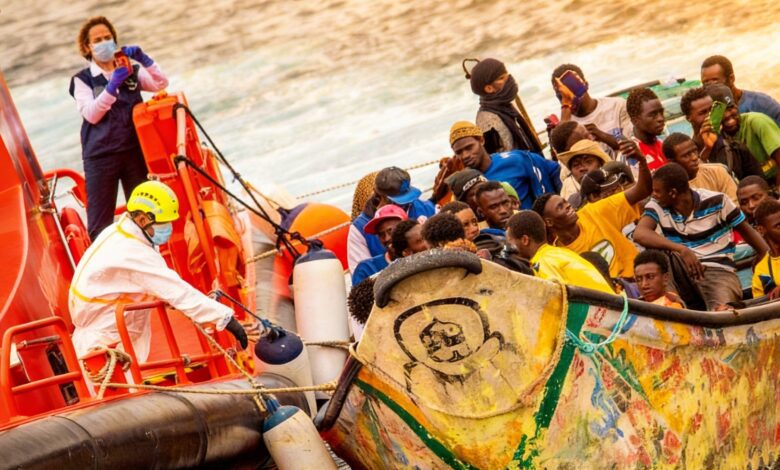
The sharp increase in the number of undocumented migrants departing from Gambia to Spain is raising concerns among Spanish authorities. In recent months, Gambia has become a key departure point for those trying to reach the Canary Islands via the Atlantic route. This trend has a direct impact on Spain, increasing the pressure on rescue services and the migration system.
According to RUSSPAIN.COM, up to 40% of migrants who set out from Gambia die or go missing along the 2,800-kilometer sea route. The high fatality rate is caused not only by the challenging journey, but also by a lack of modern border control tools. Since July, the region’s software for tracking and stopping the activity of criminal networks trafficking people has not been updated. This has created favorable conditions for mafia groups using Gambia as a launching pad for sending people to Europe.
Gaps in control
Similar systems previously operated successfully in Mauritania, where joint efforts with European bodies helped reduce the flow of illegal migrants. However, in Gambia, the lack of updated software has meant that local and international law enforcement agencies are unable to effectively identify and disrupt the activities of organized groups. According to EL ESPAÑOL, this factor has become one of the reasons for the sharp increase in border crossing attempts and the associated tragedies.
Spanish authorities note that the mass legalization of migrants, announced by the government of Pedro Sánchez in January, has intensified the so-called ‘pull effect.’ This measure is seen in West African countries as an opportunity to enter Europe, prompting more people to embark on dangerous journeys. As a result, both the number of crossing attempts and the casualty rate along the route are rising.
The cost of the journey and the role of mafias
Migrants who take this risky step are forced to pay between 5,000 and 15,000 euros for a place in a boat, depending on the region of departure. These amounts are easy money for criminal groups who have no regard for people’s safety. Spain, as the main gateway to Europe for West African migrants, is seeing a steady increase in arrivals, adding extra pressure on local authorities and rescue services.
To combat this phenomenon, Spanish police use joint operational partnerships and international investigative teams. These teams work on the ground alongside colleagues from other EU countries and African states to detect and disrupt the activities of criminal networks. However, limited resources and the need to deploy personnel to the region make the fight against illegal migration particularly challenging.
Tragedies along the route
In 2025, according to humanitarian organizations, around 1,900 people died or went missing on the Atlantic route. One of the most high-profile cases was the disappearance of a boat carrying 300 migrants that departed from Gambia in December. The vessel was last seen off the coast of Senegal, after which all contact was lost. Despite calls for large-scale search efforts, the boat was never found.
The situation is made worse by the fact that the usual journey takes from a week to ten days, yet many boats vanish without a trace. Humanitarian organizations and local residents regularly report new tragedies, but there are not enough resources for search and rescue operations. Spanish authorities are forced to respond to each new incident, which puts additional pressure on state services.
Context and consequences
The rise in illegal migration from Gambia has coincided with other crises affecting Spain. For example, recent economic shocks driven by rising fuel prices have also heightened social tensions, as noted in in a report on the impact of conflicts on the country’s economyTogether, these factors create a complex situation that requires comprehensive solutions at both the EU and national government levels.
In recent years, Spain has repeatedly faced waves of illegal migration via multiple routes. The Atlantic crossing remains particularly dangerous, as rough weather and a lack of navigation equipment have resulted in numerous tragedies. In 2024, similar incidents were recorded off the coast of the Canary Islands, where dozens of migrant boats vanished without a trace. International organizations continue to call for greater cooperation among regional countries to prevent further disasters and save lives.