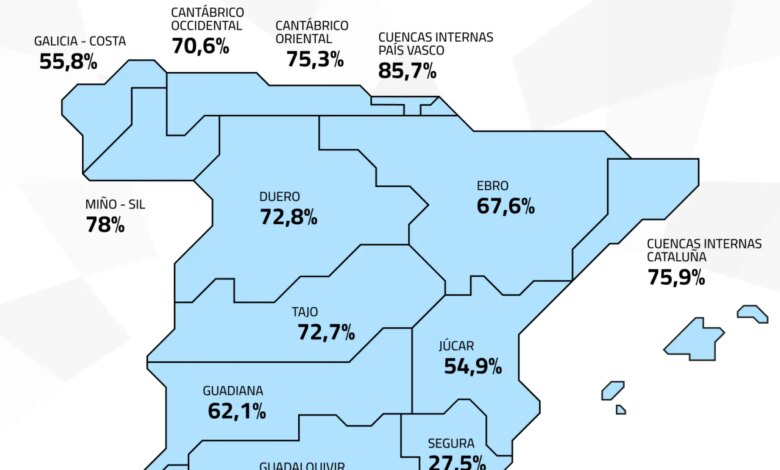
Spain continues to see a significant decrease in reservoir water levels. This week, the total volume of reserves reached 35,789 cubic hectometres, which is 63.9% of their full capacity. Over the past seven days, reservoirs lost another 1,007 cubic hectometres, equivalent to a drop of 1.8 percentage points.
The situation has remained tense for the eleventh consecutive week: water levels continue to decline, and none of the country’s major water systems have shown any increase. The only exception is the internal basins of the País Vasco, where water volume remained unchanged.
The ongoing decline is due to a prolonged period of heat that has affected Spain since early August. During this time, there was almost no rainfall, with the highest amount recorded in the province of Cuenca—only 3.6 liters per square meter.
Despite the overall decrease in reserves, most of the country’s reservoirs still maintain levels above 50% of their maximum capacity. Exceptions include the Guadalete-Barbate, Guadalquivir, and Segura river basins, where water levels are at 46.6%, 48.8%, and 27.5%, respectively.
The largest weekly decrease was recorded in the Ebro river basin—down 4%. Significant reductions were also noted in the Tinto, Odiel y Piedras basins at 3.1%, the Duero at 3%, and the Cantábrico Oriental at 2.8%. In Galicia Costa and Tajo, the drops were 2.7% and 1.7%, respectively.
Despite the ongoing decline, the current water volume in Spanish reservoirs exceeds last year’s figures by 4,725 cubic hectometers. Additionally, water reserves are now 6,605 cubic hectometers higher than the ten-year average for this time of year.
Experts note that the situation requires constant monitoring, especially against the backdrop of persistent heat and lack of rainfall. Authorities are urging prudent use of water resources to prevent shortages in the future.