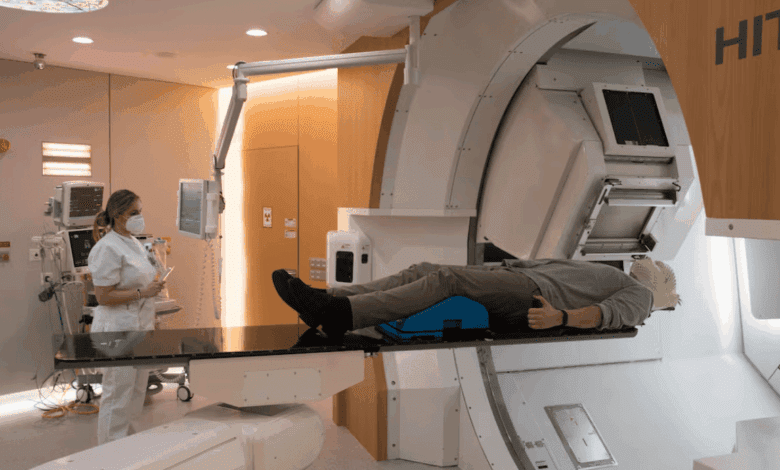
In Cantabria, where the population barely exceeds half a million, a project has been launched that is already being called revolutionary for all of Spanish medicine. This region, lacking a large budget or political stability, has unexpectedly managed to get ahead of all other autonomous communities. Here, Spain’s first public proton therapy facility is being built — a cutting-edge technology capable of treating the most complex forms of cancer, including in children. And all of this is funded exclusively with regional resources, without any help from private foundations.
While other regions such as Madrid, Cataluña, Andalucía, Valencia, Galicia, the Basque Country, and the Canary Islands wait for equipment donated by a private foundation, Cantabria is forging its own path. The regional authorities have already invested over 51 million euros in the project, which aims to spare patients from having to travel to the capital for treatment. Currently, proton therapy in Spain is available only at two private clinics in Madrid, and access is limited.
A bet on independence
The idea of creating its own facility emerged back in 2021, when the regional government, formed by a coalition of PRC and PSOE, decided not to wait for equipment purchased by a well-known entrepreneur. At that time, 27.5 million euros were allocated for the purchase of the equipment itself, and another 10 million for construction. The plan was for the first patients to receive treatment as early as the beginning of 2024. But, as often happens, the timeline shifted and the budget increased.
Now, five years later and with a new administration in power, the project is overseen by a team from the People’s Party, which has pledged to stay the course. The equipment, manufactured in Germany, is already prepared and awaiting delivery. Its cost has remained within the original budget, but expenses for design and construction have nearly doubled. Preparing the project documentation alone cost €1.3 million—twice the initial estimate. The construction costs have already reached nearly €23 million and could rise further if new challenges arise.
Technology and challenges
A large company specializing in complex infrastructure projects is in charge of construction. At the heart of the project is a 12-meter-deep bunker made of solid concrete. Such a structure is essential to ensure the safety of staff and patients, as the facility will work with high-energy protons. This engineering feat is not a whim, but a necessity of our time: only in this way can the safe and efficient operation of the facility be guaranteed.
With the launch of the new center at Valdecilla Hospital, Cantabria expects not only to stop sending its patients to Madrid, but also to treat people from other regions. The center is projected to care for about 350 patients a year. While this is not a large number compared to the whole country, it marks a real breakthrough for small Cantabria. Over the next two years, another 2.1 million euros will be allocated for the center’s maintenance and development; if the project continues, funding could reach 5 million.
Looking Ahead
Unlike other regions, Cantabria was not among the recipients of equipment purchased with private donations. Instead, authorities here chose to chart their own course, avoiding reliance on outside aid. This strategy has already paid off: the region is now in the spotlight of the country’s entire medical community. The Ministry of Health points out that the Valdecilla project is the only fully public initiative in Spain, unaffiliated with private foundations. The other systems purchased by an entrepreneur are only now being installed in other regions.
According to experts, proton therapy will be recommended for about 2% of cancer patients in the coming years, but as technologies advance, this figure may rise to 11%. In absolute terms, that’s between 700 and 17,000 people annually. Already now, according to professional associations, the demand for such procedures exceeds 15,000 patients per year.
A Test for the Region
Cantabria, despite its limited resources, chose not to wait for favors from the capital or major donors. Here, the region has relied on its own strengths—and so far, it appears to be paying off. If the project is completed on time, the region will not only provide its residents with cutting-edge medical treatments, but could also become a magnet for patients from across the country. This is more than just a medical initiative—it’s a challenge to the established system, where money and connections often decide everything.
While other regions are still preparing to launch their centers, Cantabria is already nearing the finish line. The only question is whether it can maintain the pace and avoid getting bogged down in bureaucracy or rising costs. But even if there are further delays, the very fact that such a center is appearing in a small region is already a victory—and potentially a model for the entire country.