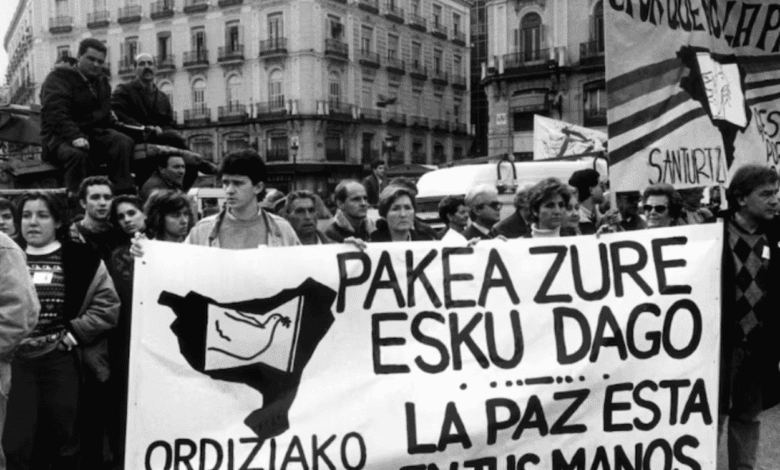
At the end of November 1985, a series of tragic events unfolded in the Basque Country (Euskadi): several members of the security forces were killed over the course of two days. These murders shocked local residents and became the starting point for a unique movement that changed the approach to combating political violence. The day after another attack, around two hundred people, mainly young people, gathered at Circular Square in Bilbao. They stood in complete silence, protesting against the killings. This was the beginning of Gesto por la Paz—the first mass movement to take a stand against violence in the region.
The idea was born within the walls of the Catholic college Escolapios, where a group of young people without any political or religious affiliation spent long hours discussing how to confront the wave of terror. Among the founders were Imanol Zubero, Txema Urquijo, Itziar Aspuru, and Jesús Herrero. They decided that after every killing—regardless of who committed it, whether ETA, GAL, or the police—a fifteen-minute silent demonstration would be held the following day.
From the very start, participants faced misunderstanding and even hostility. Many were afraid to speak out against violence openly, fearing consequences and condemnation. Even those who opposed terror were not always ready to join the demonstrations. The silent protests made not only radicals uncomfortable, but also ordinary citizens and political parties, as the movement did not differentiate between victims and condemned all acts of violence.
Expansion of the Movement and New Forms of Protest
Within its first year, Gesto por la Paz expanded to twenty groups in Bilbao and its surroundings. By 1990, activists from Gipuzkoa and Álava had joined, leading to the creation of a coordinating structure. In 1992, the annual demonstration along Bilbao’s main street drew thousands, and soon events began to take place in smaller towns as well. For participants, it was important not only to have a strong presence in the capital, but also to show local support.
Public reaction was especially notable in cases of kidnapping. In 1993, when San Sebastián businessman Julio Iglesias Zamora was held by terrorists for 116 days, silent rallies were held daily outside the courthouse in Bilbao. The movement gained broad support in universities and among the intelligentsia. It was during this period that the blue ribbon—worn by those who openly opposed violence—became a symbol of the movement.
By the mid-1990s, Gesto por la Paz counted around two hundred groups. In 1993, the movement was awarded the prestigious Premio Príncipe de Asturias, earning international recognition. Activists emphasized that violence did not reflect the will of the majority and that its supporters represented only a small fraction of society.
Conflicts, Challenges, and New Campaigns
As the movement gained popularity, participants faced aggression and pressure. After the kidnapping and murder of politician Miguel Ángel Blanco in Ermua in 1997, mass protests broke out across the country. Gesto por la Paz played a key role in organizing the largest demonstration in Bilbao’s history, where thousands demanded the release of the hostage.
However, the unity of democratic forces soon began to crack. In 2000, after the murder of socialist Fernando Buesa in Vitoria, society split into two camps—sovereignty supporters and constitutionalists. This division was reflected in the movement, which continued to hold silent protests despite pressure and attempts to discredit it.
In the mid-1990s, Gesto por la Paz launched a campaign against the so-called ‘dirty war’ and advocated equal treatment for all victims of political violence. Among its slogans were calls to end the killings and to prevent democracy from becoming a victim of its own methods.
Twilight of an Era and Social Impact
At the start of the 2000s, the terrorists changed tactics, targeting well-known politicians and public figures, which sparked mass protests. The movement continued to organize silent demonstrations, though their impact gradually diminished. After José Luis Rodríguez Zapatero came to power and negotiations began with ETA, the number of attacks dropped significantly.
Some activists who opposed dialogue formed their own political group, but Gesto por la Paz remained true to its principles. The movement became an example of how civic initiative can change society’s attitude towards violence and demonstrate that even silence can become a powerful weapon in the fight for peace.