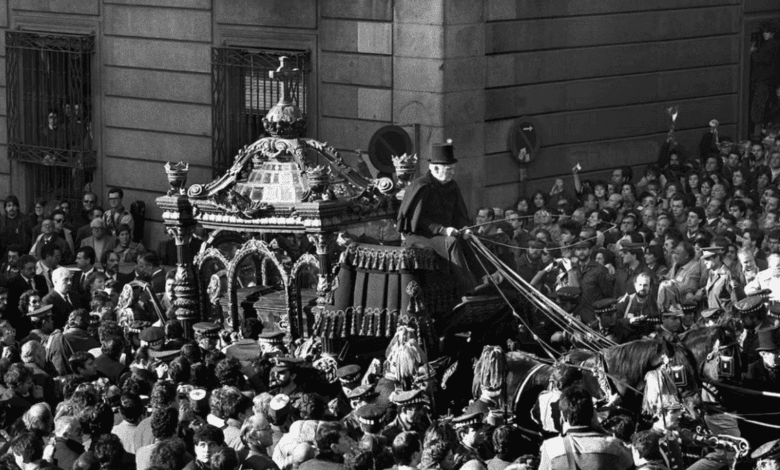
In January 1986, Madrid came to a standstill. The city was bidding farewell to a man who had become much more than just its mayor. Enrique Tierno Galván passed away at the age of 67, leaving behind not only a political legacy but also a unique atmosphere still remembered with warmth and respect. Crowds filled the streets—more than a million people turned out to accompany him on his final journey. In the hall where the chapel was set up, lines never seemed to end: tens of thousands wanted to say their goodbyes in person.
The funeral organizers did not expect such a turnout. They had to urgently change their plans: the procession with the coffin through the city center took three times longer than anticipated. The televised coverage by Pilar Miró became a national event. For the farewell, an antique carriage drawn by six black horses was specially brought from Barcelona. Everything proceeded calmly, without incident, but left an overwhelming emotional impact.
A city legend
Tierno Galván became a symbol of an era of change. He was known as an ‘honest socialist,’ but this label only hinted at the complexity of his character. He was a man who could unite people from all walks of life. At the farewell ceremony, nuns stood side by side with punks sporting bright mohawks. He was not just a politician—he was someone who truly knew how to connect with everyone.
Former Deputy Mayor Juan Barranco recalls how Madrid’s current mayor helped organize commemorative events. According to him, Tierno Galván possessed a rare blend of intellect and humility. He was called a “familiar enlightener”—and this, perhaps, best captured his distinctive style.
New approaches
Pilar Fernández, who worked as a lawyer at the time, left her profession to join Tierno’s team. She remembers that in those days Madrid didn’t even have a proper social services system—only charity. It was under Tierno that the city’s first structure focused on helping and supporting residents appeared. His aim was simple: to make Madrid a city for its citizens, not for subjects.
Tierno often surprised colleagues with his management style. He never gave direct orders, preferring gentle suggestions like: “It would be good if this could be resolved,” or “It might be interesting to look into this.” But everyone understood: if he requested something, it had to be done. He was respected for his ability to listen and his phenomenal memory.
A bridge between eras
Tierno Galván was a man equally at home in academic circles and on the city’s streets. He could quote Wittgenstein, and an hour later support youth movements that would later be known as the Movida. His style—a mix of scholarly erudition and street-level openness—set a new standard for city leadership.
In 1982, when Pope John Paul II visited Spain, it was Tierno who welcomed and saw him off, doing so in Latin. He earned respect not just for his knowledge but also for his ability to connect with everyone. He wasn’t afraid of change and supported cultural initiatives that transformed Madrid.
A City of Change
In the early 1980s, Madrid was a city confined by bureaucracy and the aftermath of dictatorship. Inequality, slums, and lack of infrastructure demanded urgent solutions. Tierno’s team took on the challenge with enthusiasm. During that era, landmarks like IFEMA, the planetarium, and Mercamadrid emerged. Even the ducks on the Manzanares River are part of his legacy.
But the most important change was in the city’s spirit and the way residents saw themselves. Madrid became a place where everyone could feel part of a larger community. The “Movida” wasn’t just a youth movement—it was an explosion of energy, championed by the mayor himself. The city began to breathe in a new way.
More Than Words
Today, many remember Tierno Galván for his famous quotes or striking photos from concerts. But behind this image was a much deeper personality. He had a knack for showing up at the right moment, saying what mattered, and being remembered not only as a politician but also as someone who truly loved his city.
It’s rare to find a leader who’s equally close to academics, young people, and ordinary citizens. Tierno Galván became what is still called Madrid’s ‘true mayor.’ His legacy lives not only in monuments and street names but in the very spirit of the city he helped create.