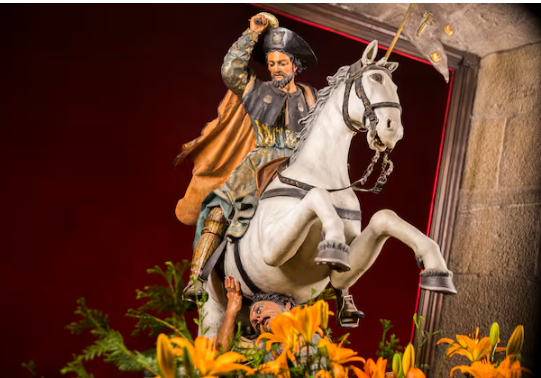
Spanish history is full of examples where fiction became reality for entire generations. One of the most striking cases is the story of the miraculous Christian victory over the Saracens at Clavijo and the subsequent introduction of a special tax in favor of the church of Santiago de Compostela. According to legend, in the 9th century, King Ramiro I supposedly saw the apostle Santiago in a dream, who promised his help in battle. The next day, the saint appeared on a white horse and helped secure victory, freeing the Christians from the annual tribute of a hundred maidens. This story became the foundation for a powerful cult and financial flow that nourished the church structures of Galicia for centuries.
However, modern historians are convinced that neither the battle nor the miraculous intervention ever occurred. The tale was cleverly woven from various chronicles and myths, and the key documents supporting it were fabricated in the 12th century. The main architect of this hoax was canon and cardinal Pedro Marcio, who created a forged charter known as the Privilegio de los votos. This document supposedly confirmed King Ramiro I’s will and secured the church of Santiago’s right to annual payments from all over Spain.
A financial empire
The introduction of the tax known as the Voto de Santiago became a powerful economic lever for the Church. At first, peasants were required to give a portion of their harvest and wine; later, these payments became monetary. The funds were used to adorn the cathedral, build new structures, and maintain a large number of clergy. Thanks to these resources, masterpieces such as the Pórtico de la Gloria and the stone choir by Maestro Mateo were constructed.
Resistance to these taxes grew with each passing decade. Peasants and ordinary townspeople increasingly voiced their dissatisfaction, as only church and court circles benefited. Nevertheless, the tax endured for more than five centuries and was abolished only at the beginning of the 19th century, after the Cortes de Cádiz and the death of Fernando VII.
Myths and Forgeries
In the Middle Ages, document forgery was commonplace. Fake charters and privileges allowed the Church and nobility to acquire new lands, incomes, and influence. The Privilegio de Votos became one of the largest-scale frauds, with consequences felt for centuries. Even if the forgery was based on some real prototypes, its main purpose was clear—to ensure a steady flow of funds into the treasury of Santiago de Compostela.
At the same time, the image of the apostle Santiago as a warrior and protector of Christianity was also taking shape. His cult was actively promoted through art, literature, and architecture. In the 12th century, the Order of Santiago (Orden de Santiago) was established, and the Pope officially recognized a tax in favor of the cathedral. All of this made Santiago de Compostela not only a religious center but also a political one, comparable to Jerusalem and Rome.
Pilgrimage and Relics
The legend of the miraculous discovery of the apostle’s tomb in Galicia became another key element of this story. It is believed that in the early 9th century, an ancient skeleton was found near Compostela and declared to be the remains of Santiago. From that moment, the city became a destination for mass pilgrimage. Over the past year alone, more than half a million people arrived here, nearly three hundred thousand of them foreigners.
In the Middle Ages, the cathedral’s prestige was maintained not only by taxes but also by its collection of relics. In 1102, Archbishop Diego Gelmírez (Diego Gelmírez) committed a daring act: during a visit to Braga (Braga, Portugal), he took many holy relics from there, justifying it as an effort to preserve them. In Portugal, this was called theft; in Galicia, a pious deed. This episode became known as Pío Latrocinio—’the pious theft.’
The Perspective of Modern Researchers
Today, historians and art experts continue to explore how myths and forgeries have shaped the image of Santiago de Compostela. In their research, they note that the cult of the apostle and the related traditions were largely the result of deliberate propaganda and the economic interests of church leaders. Even the very discovery of the remains of Santiago is questionable: the skeleton found belonged to a decapitated man, and there is no evidence that it belonged to the apostle, who, according to legend, never visited Spain.
Nevertheless, the flow of pilgrims shows no sign of abating, and the legends continue to live on in art, architecture, and public consciousness. Santiago de Compostela remains one of the main symbols of Spanish history, where fact and fiction have become so tightly intertwined that separating them is nearly impossible.
If you didn’t know, the Cathedral of Santiago de Compostela is not only an architectural masterpiece, but also the focal point of one of Europe’s most famous pilgrimage routes—the Camino de Santiago. Every year, hundreds of thousands of people from all over the world come here. Archbishop Diego Gelmírez, who played a key role in elevating the city, is considered one of the most influential church figures of medieval Spain. Streets in Galicia’s largest cities bear his name. The cult of the apostle Santiago has had a profound impact on the formation of Spain’s national identity and religious traditions.