Elections in Extremadura have concluded, delivering unexpected results for all major political forces. The Partido Popular (PP) won a convincing victory, securing 29 seats in the regional parliament and collecting 43.2% of the vote. The Socialists (PSOE) suffered their worst result in history, limited to 18 seats and 25.7% support. The results may change slightly after counting overseas ballots, but no significant shifts are expected.
Vox significantly strengthened its position, increasing its number of deputies to 11—six more than last time. This result opens the door for the party to participate in forming a coalition government alongside PP. The United Left (Unidas por Extremadura) also improved its performance, winning seven seats, up by three compared to the previous year.
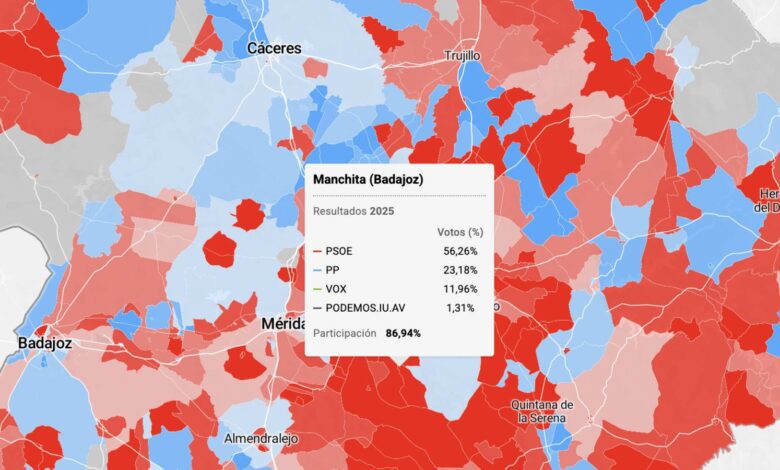
Voting Map
A detailed analysis by polling station reveals how residents’ preferences were distributed not only in cities, but also across specific districts. Extremadura has 966 voting precincts. PP prevailed in 759 of them, accounting for 78%. PSOE led in 190 precincts (19.6%), while Vox came first in 14 (1.4%).
This breakdown points to clear PP dominance across almost the entire region. However, in certain areas, Socialists and Vox achieved local successes, especially in urban neighborhoods with varying social compositions.
The impact of income level
Interestingly, voting results vary significantly depending on income levels. In sections where the average income is above the provincial average, PP wins 92% of the time. In less affluent areas, this figure drops to 66%. For PSOE, the situation is the opposite: in lower-income sections, the party leads in 31% of cases, but in wealthier areas—only 7%.
These figures confirm that economic factors remain a key driver of political preferences among residents of Extremadura. Vox and Unidas por Extremadura have not achieved significant success in any income category, but their support is growing in specific sections.
City map
In Cáceres, the PP won almost every district, losing only one—Aldea Moret, where most voters supported the Socialists. In Mérida, the situation is similar: PP leads almost everywhere, but PSOE managed to win in six sections. In Badajoz, the vote was more evenly distributed: here, both the Socialists and Vox managed to win in a number of districts.
This distribution shows that even in cities dominated by one party, there are still neighborhoods with differing political leanings. It reflects the complex social structure and diversity of views among residents of the region.
Methodology
Income levels were determined using data by sections, divided into three groups: above the median (percentile 55 and above), around the median (between 45 and 55), and below the median (percentile 45 and below). This breakdown made it possible to identify how economic status influences political preferences.
All data are based on the latest income distribution atlas published by the National Institute of Statistics (INE) in 2023. The election results by section remain preliminary, but no significant changes are expected after the final count.