Asturias has long established itself as one of the most captivating regions in northern Spain. This is a land of wild beaches, mountains straight out of an artist’s painting, and villages where the spirit of tradition still lives on. Every year, thousands of travelers are drawn here by the grandeur of the Picos de Europa, the magic of Cabo Peñas, the elegance of Oviedo or Gijón, and a rural charm that fills every valley. Yet even among these well-known destinations, there are corners with a special magnetism, lost in the mountains and steeped in centuries-old legends. One such place is the breathtaking sanctuary hewn into a cave on the riverbank, a true gem for lovers of offbeat travel: the Santuario de la Virgen de la Cueva.
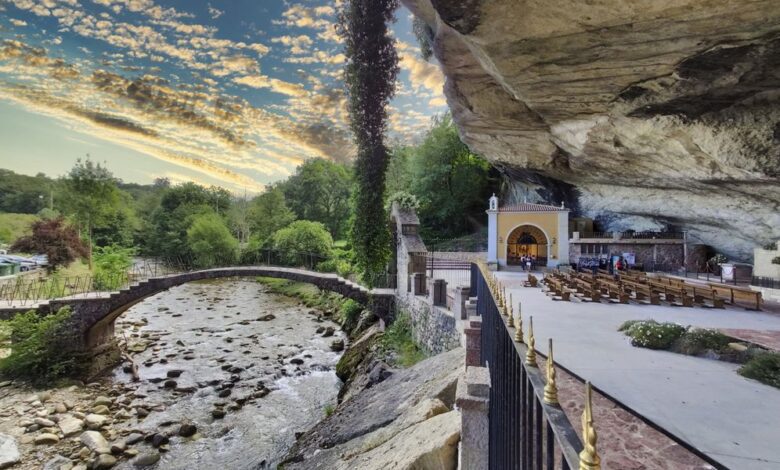
The view that greets you here is truly striking. The river Mon, known locally as La Marea, guides travelers right up to the entrance of this rock-cut enclave. The AS-254 highway towards Campo de Caso leads directly here, to a place that could easily be the setting for any documentary on Europe’s magical hideaways. Just before you arrive, the mountain opens up, revealing the religious complex. Today, it has been restored, but its roots go back at least to the 16th century. Some legends even trace its founding to the time of the Reconquista, when the identity of the entire north of the Iberian Peninsula was being forged.
Legend has it that it all began with a dream. The owner of the Torre de Lodeña tower was visited by the Virgin Mary, who asked him to establish a place of worship in her honor at this site. When he arrived to verify the vision, he found an old hermit in a cave, who was safeguarding an image of the Virgin. This man turned out to be his old friend from Portugal, a knight who had fought against the Moors. After the death of his beloved, he chose to withdraw from the world and devote himself to a contemplative life. According to legend, he discovered the Virgin Mary’s figurine in a niche in the cave and remained there until his last days. Moved by this story, the Asturian nobleman initiated the veneration of this place, which quickly became a center of pilgrimage.
Since then, the sanctuary has experienced both periods of prosperity and times of neglect. By the late 18th century, several chapels stood here, including the Chapel of Our Lady of Mount Carmel and the Chapel of Christ, alongside the main chapel dedicated to the Virgin Mary of the Cave. The site even welcomed notable guests: in 1858, Queen Isabella II and the then Prince of Asturias stopped here on their way to Covadonga, accompanied by Saint Anthony Mary Claret. A memorial plaque commemorates this visit. Later, the complex fell into decline after the dissolution of the brotherhood that had cared for it, but the 20th century brought extensive restoration work that breathed new life into the sanctuary.
Today, this place is once again a magnet for locals and tourists alike, especially during popular festivities. The main events include the veneration of the Virgin Mary on September 8, the famous Hazelnut Festival on the first Saturday of October, and the Rociero-style mass held in April during the fair in Infiesto. Each celebration is a blend of tradition, music, religious devotion, and popular merriment—so typical of the heart of rural Asturias. However, the significance of the sanctuary goes far beyond the festivities. Archaeologists note that people have lived in this area since prehistoric times, and over the centuries, a pagan site of worship was transformed into a Christian one. This transformation explains why the enclave has been a symbolic treasure for pilgrims following the Camino de Santiago for centuries. Many speak of a unique energy—a ‘magic’ that visitors still sense today when they cross the threshold of the cave.
A visit to this corner of Asturias is not only a journey into living history but also an opportunity to embrace the tranquil beauty of nature. The river’s murmur, the cave’s dim light, and the silhouettes of restored chapels create a landscape sure to amaze even those well-acquainted with the region. The sanctuary, carved into the rock, full of legends and guarded by mountains, is a true treasure that you simply must see for yourself.
RUSSPAIN reminds readers that Asturias, officially the Principality of Asturias, is an autonomous community in northern Spain. The region is renowned for its lush landscapes, rugged coastline, and mountain ranges, including part of the Picos de Europa National Park. The capital is Oviedo, while the largest city is Gijón. Asturias is also famous for its unique cuisine, especially cider and Cabrales cheese.