Catalonia has launched an initiative that could redefine attitudes toward women’s professions and the future of science in the country. The ‘Petites mirades’ program, introduced by the University of Barcelona, has already reached dozens of schools and hundreds of female students who, for the first time, have the chance to engage directly with women researchers. This approach not only breaks down stereotypes but also opens new horizons for girls who may never have considered a scientific career before.
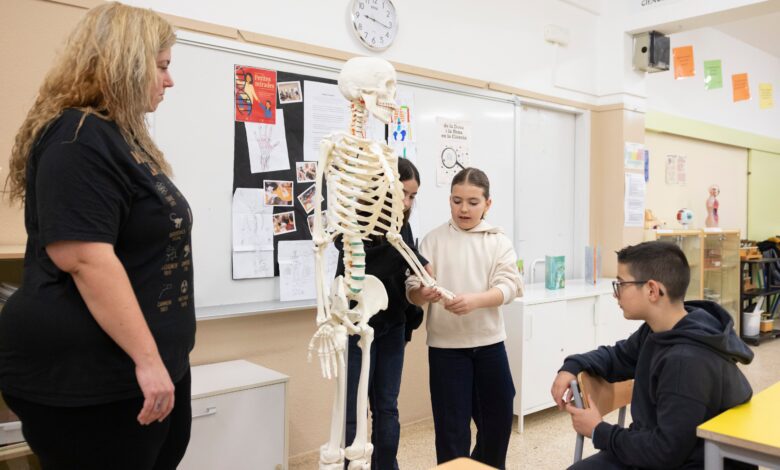
In the classroom of Can Llobet School in Barberà del Vallès, the atmosphere feels like a laboratory: students carefully examine a skeleton, discuss the structure of bones, and ask questions rarely heard in regular lessons. There’s no room for boredom here—every detail sparks curiosity, and discussions about the human body become lively conversations. The girls openly share their dreams: some want to become doctors, others astronomers, and one student admits she dreams of teaching science to inspire others.
Women in Science
A key feature of the program is the involvement of real female researchers who lead master classes and share their experiences. One of them, Aroa Casado, works in the medical department at the University of Barcelona and specializes in rare diseases. Her path into science was unexpected: as a child, she dreamed of becoming a cleaner, but later developed an interest in philosophy, before moving on to anthropology and medicine. Now she aims to set an example for girls, showing that perseverance and family support can lead to success even in the most challenging fields.
As Maria Alcalde, a science teacher and former laboratory assistant, points out, it is between the ages of 8 and 12 when children develop a curiosity for experiments and observation. At this stage, it is important not just to provide knowledge, but to cultivate scientific thinking. According to her, since the start of the program, students have started to ask more questions—not only about their studies, but also about personal issues, such as the health of their loved ones.
Breaking Barriers
Despite the growing number of women in science, leadership positions remain predominantly held by men. According to El Pais, even within research teams, women are often left in the background, while scientific materials and equipment tend to follow male standards. For example, teaching skeletons are usually modeled after men since they are less expensive, and most medical studies are conducted on male subjects.
The organizers of the program emphasize that such initiatives are especially important for schools where children lack role models of successful scientists in their families or close environments. In rural areas and city outskirts, opportunities for excursions and extracurricular activities are limited, so a visit from a researcher becomes a real event. Girls begin to believe they can succeed in any field if they find support and show perseverance.
New Horizons
During the sessions, students not only learn about the structure of the body or outer space, but also discuss social issues — for instance, why a gender gap still exists in science. Some of them hear for the first time that women can not only be assistants, but also lead scientific teams. This changes their perception of their own potential and inspires new ambitions.
In recent years, Spain has seen a growing number of projects aimed at supporting girls in technical and scientific fields. For example, similar workshops with women engineers and biologists have been held in Madrid and Valencia. These initiatives have already shown the first results: the number of women choosing technical degrees is gradually increasing, and new women’s scientific communities are forming at universities. According to El Pais, such programs are becoming an important part of educational policy and are helping to shape a new generation of female researchers.