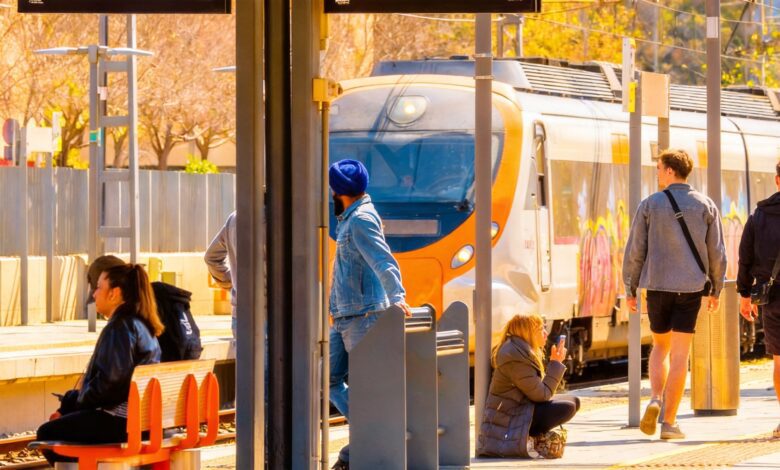
The issue of passenger information at Barcelona’s railway stations is once again in the spotlight. Malfunctioning screens and Rodalies’ notification system failures are causing confusion and delays, directly impacting daily life in Catalonia. For many Spaniards who rely on commuter trains, these disruptions mean lost time, added stress, and erode confidence in the region’s transport system.
Persistent disruptions
According to El Pais, at major stations such as Sants and Estació de França, passengers frequently encounter situations where the information displayed on screens does not match the actual service. Announcements about train arrivals are often incorrect: a train may arrive at a different platform than indicated, and loudspeaker alerts do not always play on time. As a result, people are forced to hurry between platforms so as not to miss their train, leading to chaos and frustration.
The causes of these failures lie in outdated infrastructure and insufficient funding, as previously stated by Sílvia Paneque, head of the Territorio department of the Generalitat. She reported that when the administration transferred to PSC, numerous issues needing urgent attention were discovered. Despite promises to modernize the information system, a year after these major announcements the situation has changed little: screens still mislead travelers, and passengers continue to face the same problems.
Internal processes and responsibility
As El Pais reports, train traffic is managed at the Adif Traffic Regulation Center (CRC) at Estació de França. Here, Adif and Renfe specialists coordinate routes and respond to incidents in real time. However, despite the center’s rapid response, information displayed on the screens and alert systems is often delayed or not updated during schedule changes. This is because some screens are serviced by Adif and others by Renfe, making data synchronization more complicated.
According to Renfe’s representative in Catalonia, Antonio Carmona, during emergencies, such as a train breakdown or a sudden route change, information doesn’t always update at all stations in time. As a result, passengers receive outdated or conflicting messages, which is especially problematic during rush hour. While officials assure that dividing responsibility between Adif and Renfe does not affect efficiency, in practice passengers still experience inconvenience.
Attempts to improve service
Renfe claims that after criticism from Sílvia Paneque, a plan was launched to strengthen mobile information teams and introduce new communication channels, including WhatsApp. The company is also updating digital boards and the alert system at 80 stations in Barcelona. However, company representatives admit that when schedules change quickly, the software does not always manage to transmit up-to-date information to the screens, resulting in disruptions.
Passengers note that such issues have become routine. According to RUSSPAIN.COM, many Barcelona residents no longer trust the information displayed on screens and prefer to check train numbers and destinations themselves. In February, when another failure disabled screens and loudspeakers for an hour, Renfe recommended relying on the signs on the trains, reminiscent of pre-digital times.
Context and consequences
Information problems are made worse by ongoing repair works and speed restrictions on dozens of railway sections. According to El Pais, Adif currently maintains 183 temporary speed restrictions and is working on 31 stretches. This further complicates the situation for passengers, making them especially attentive when boarding.
Railway issues in the region are not limited to information challenges alone. Recently, rail links between Barcelona and France were completely suspended for seven weeks due to the emergency condition of the Rubi tunnel, which also sparked discontent among residents and businesses. Such events highlight the need for a comprehensive modernization of Catalonia’s railway infrastructure.
In recent years, Spain has been experiencing regular disruptions in suburban and intercity train services, especially in major cities. In 2025, Madrid and Valencia also saw widespread delays due to technical issues with information and traffic management systems. In some cases, passengers had to wait on platforms for 40 to 60 minutes without any explanation for the delays. These incidents highlight that the problem is not limited to a single region and call for a nationwide systemic approach.