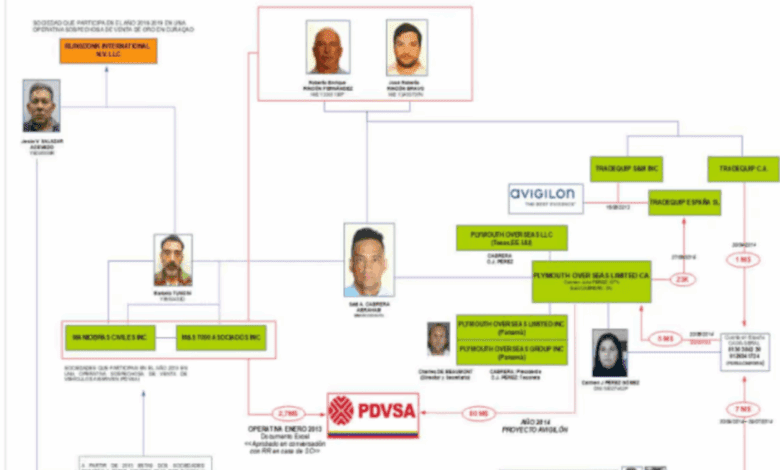
Spanish law enforcement has secured the arrest of Said Aurelio Cabrera Abraham in Qatar. Cabrera, a former Venezuelan military officer, was long considered the right-hand man of Hugo Armando Carvajal, better known as “Pollo.” Carvajal, the former intelligence chief under the Chávez regime, is now in a U.S. prison, while his closest associate has found himself at the center of a major investigation into embezzlement at state oil company PDVSA.
Cabrera’s arrest became possible after Spain’s National Court (Audiencia Nacional) issued an international warrant for his detention. Qatari police acted swiftly: Cabrera was apprehended and is now awaiting extradition. Spanish investigators suspect him of orchestrating an elaborate money laundering scheme and being involved in at least two major operations siphoning funds from PDVSA.
One of these schemes involved purchasing vehicles at inflated prices, with cars bought at twice their market value. Another concerned a contract for installing a video surveillance system, for which over six million euros was paid—funds that ultimately ended up in accounts controlled by Cabrera.
Shadows of the Past
Said Cabrera, a native of Caracas now aged 51, has always preferred to stay in the shadows. There are very few publicly available photographs of him. However, in 2014, he was caught on camera as he welcomed ‘Pollo’ Carvajal at Caracas airport, following Carvajal’s detention in Aruba and subsequent release by US authorities. At that time, Cabrera was part of the official delegation accompanying Carvajal.
Today, Carvajal is serving time in New York, where he faces charges of drug trafficking and supporting the Nicolás Maduro regime. Back then, Cabrera worked under him at Venezuela’s Directorate General of Military Counterintelligence (DGCIM). It was this experience and network of contacts that enabled him to construct a sophisticated system for moving money abroad.
In 2021, Cabrera obtained Spanish citizenship, and even earlier, in 2017, he bought an apartment in Madrid. After an investigation against him for suspected money laundering began in the Dominican Republic, he relocated permanently to Spain. Yet, even there he found no peace: for nearly five years, Spanish investigators tried to track him down, suspecting he had used a PDVSA subsidiary to run vehicle-related schemes and launder funds.
Millions on Wheels
In April 2024, UDEF (Economic and Financial Crime Unit) officers arrested two people and conducted searches at several locations, including Cabrera’s home in Portugal. The main suspect could not be found at the time, and an international warrant was issued. Only now, months later, has the warrant taken effect—with Cabrera taken into custody.
Court documents have shed light on the details of the scheme. It all began in 2013-2014, when Cabrera held a post in Venezuela’s Ministry of Defense. Investigators obtained emails showing him acting as an official representative of the ministry and as the coordinator of events related to Hugo Chávez’s death.
Roberto Esteban Rincon and his son, Jose Roberto Rincon, were also implicated in the vehicle sale scheme. They used an American company to resell cars to PDVSA’s subsidiary, Bariven, at a steep markup. The link between Cabrera and the Rincon family is confirmed not only by their joint dealings but also by multimillion-dollar invoices exchanged between them.
Surveillance system
The second part of the investigation concerns the creation of Plymouth Overseas Limited, which received a contract from PDVSA to install a video surveillance system. Between April and July 2014, more than six million euros were deposited into accounts linked to Cabrera and his business partner Carmen Julia Pérez. These transactions raised suspicions among financial analysts, as the money was quickly transferred to accounts in Spain and Portugal, and shell companies were set up to launder the funds.
Interestingly, Cabrera used the same email address to run this scheme that he had used to apply for Spanish residency documents. This was far from sophisticated cover, but apparently, he was confident he would not face consequences. According to investigators, the money ended up in accounts opened specifically for these operations, while a network of companies helped disguise its origins.
In 2015, the car dealership came under the control of Jesús Vidal Salazar, who, according to investigators, is connected to Diosdado Cabello—one of the key figures in the Venezuelan regime. This gives the case a political dimension and highlights the scale of the corruption network.
The Spanish Connection
Cabrera’s story is not just another episode in the long series of corruption scandals involving PDVSA. It shows how easily money siphoned from Venezuela ends up in Europe, with Spanish citizenship becoming a tool for legitimizing questionable wealth. However, even an EU passport did not save Cabrera from arrest.
Spanish authorities are showing that they are prepared to go all the way in fighting international corruption, even when it involves high-profile individuals with dual citizenship. The real question is how many more such cases are hidden behind the facades of luxury homes in Madrid and Lisbon. And who will be the next to draw the attention of investigators?