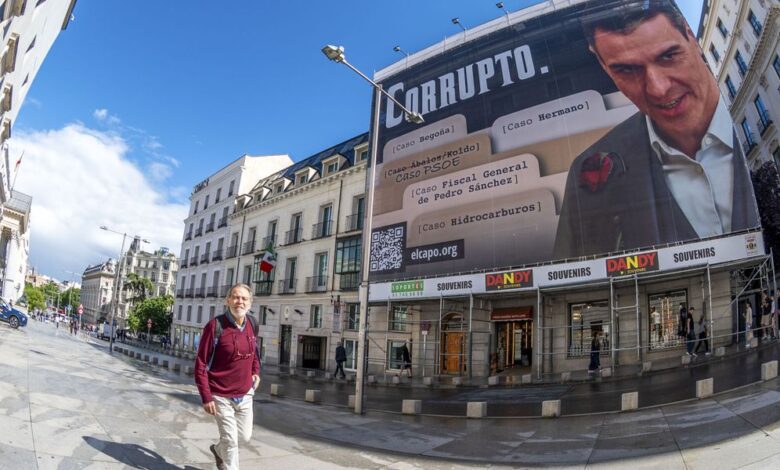
A fresh wave of scandal is erupting in the Spanish capital over a street campaign targeting Prime Minister Pedro Sánchez. The Madrid judicial authorities have ordered a specialized police unit to investigate whether provocative messages accusing the country’s leader of corruption are still being put up.
It all began back in May, when a massive banner appeared on the building opposite the Congress of Deputies, featuring Sánchez’s image and a message accusing him of corruption. The banner also listed high-profile cases involving those closest to the prime minister—from his wife to his brother—as well as other major government investigations.
After the court ordered the removal of the controversial banner, activists did not stop. New posters began appearing around the city, along with messages projected onto buildings using light. In addition, trucks displaying similar slogans drove through the streets of Madrid. The campaign attracted widespread media attention and raised concerns within the prosecutor’s office.
At the end of September, the hate crimes prosecutor insisted on determining whether the campaign was still ongoing. Investigators also requested photographic evidence collected by forensic experts and sought to question one of the leaders behind the initiative.
A court order signed last week instructs the police not only to determine whether messages of this kind are still being circulated, but also to identify exactly who is managing the vehicles used for this purpose. Special attention is being paid to identifying individuals involved in organizing and coordinating the campaign.
The team assigned to the investigation specializes in combating radical movements and terrorist threats. Usually, their operations are conducted in complete secrecy, but this time the case has attracted public attention because it affects the highest ranks of government.
Pedro Sánchez himself is listed as the victim in the case. The court partially granted the prosecutor’s request, who had previously insisted on holding one of the leaders of the movement responsible for organizing the protest.