Until the end of January, the Museum of Romanticism in Madrid is hosting an unusual exhibition dedicated to 19th-century women’s portraits. The display, titled “Retratadas,” completely redefines how we imagine women posing for the camera in that era. Rather than passive subjects, the women here reveal a whole world of choices, hidden gestures, and subtle hints—ways they found to express themselves despite strict social conventions.
The project’s curator, Stéphanie Onfray, spent years studying thousands of photographs to show that every pose, accessory, or glance was no accident; each was shaped by a private dialogue and a desire to assert one’s individuality. The exhibition brings together images of all kinds of women: aristocrats, actresses, ordinary townsfolk, and mothers. Despite the limitations of their times, they each found ways to influence how posterity would see them.
The secret room and women’s freedom
A special feature of the exhibition is the so-called ‘fourth boudoir’—a small room where women prepared for their photo sessions. It was here, away from prying eyes, that they could consider how they wanted to appear in the photograph. In Spain, France, and England, such rooms were true laboratories of female self-expression. Here, ideas for poses were born, jewelry and outfits were chosen, and details of the future portrait were discussed. As a result, even within the strictly regulated setting of the photo studio, women managed to assert their preferences—be it an unusual hairstyle or a favorite piece of jewelry.
Interestingly, it was often the client herself who made the final decision about how her portrait would look. It was a kind of exchange: the photographer would offer options, but the final say remained with the woman, since she was the one paying for the work. This approach allowed women to feel in control—at least for a little while.
Photography as a language and a tool for change
In the 19th century, the advent of ‘calling cards’ was a real revolution. Thanks to them, portraits became accessible not only to the elite but to the wider public. Women gained the opportunity to experiment with their image, to try on new roles—from professionals to military figures—something previously unthinkable. Fashion, accessories, even poses—all became a kind of code through which they could tell more about themselves than words ever allowed.
The exhibition shows how fashion evolved from mere decoration into a true language of self-expression. Dresses, fabrics, hairstyles, and jewelry—all of these were used to convey emotion, status, or even to protest against established norms. Among the heroines are not only women of the aristocracy but also actresses who used photography to promote their careers. In some cases, photographs even became a commercial tool—for instance, some women distributed their portraits to advertise their own services.
Five Acts of Women’s History
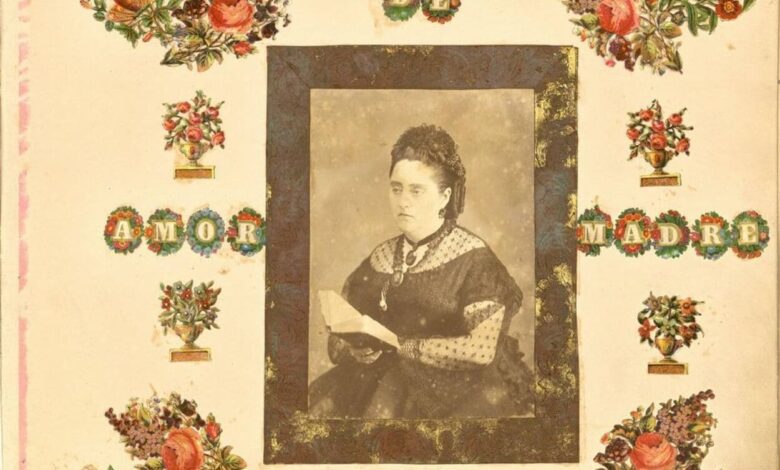
The exhibition is organized as a journey: from preparing for the photo shoot to the emergence of new female identities at the turn of the centuries. Visitors first enter the intimate space of the boudoir, then move on to a hall exploring the themes of the body and fashion. The next section is dedicated to ‘metaphotography’: here, you’ll see albums, family heirlooms, jewelry made with hair, and even post-mortem photographs, giving the exhibition a unique depth.
The finale shifts focus to women who not only posed but also took up the camera themselves. These were the first steps toward women becoming photographers, as well as the creation of new roles—not just mothers or beauties, but professionals, individuals with their own desires and ambitions. The exhibition is accompanied by a catalogue that thoroughly examines every stage of this fascinating process.
“Retratadas” is not just a collection of old photographs, but an attempt to offer a fresh perspective on the role of women in the history of photography. Here, every detail becomes a key to understanding how, even within the strictest boundaries, there was room for freedom and self-expression.