During the Spanish Civil War, Madrid’s subway became much more than a simple means of transport—it turned into a vital hub for thousands of city residents trying to survive. The stations and tunnels, built back in 1917, found themselves at the heart of the conflict: people took shelter from air raids there, ammunition and food were transported through the network, and military units were even stationed underground. Despite constant threats, the metro operated around the clock, and its role in city life changed dramatically.
Management of the metro during this period passed to a workers’ council comprised of union representatives. After nationalization, the old board of directors was dismissed, and key decisions were made by new leaders determined to keep the system running even amid chaos. In the first months of the war, there were denunciations and purges within the staff: employees suspected of sympathizing with the opponents of the Republicans were fired or put on trial. Many received actual prison sentences, though no death sentences were handed down.
With the return to work of employees previously dismissed for participating in protests, as well as the mass conscription of men into the army, new faces appeared in the metro. Women took on key roles: not only selling tickets and checking passes, but also driving trains, operating stations, and working in technical services. Some, like Julia Jiménez Sáez, drove trains that transported not only passengers, but military cargo as well. After the war ended, many of these women faced repression.
Explosions and Disasters: Tragedies Underground
Military operations led to parts of the metro lines being closed to civilians, and stations being used as ammunition depots. One of the most tragic incidents was the explosion at Lista station in January 1938, when the room storing artillery shells was completely destroyed. The exact number of casualties remains disputed: estimates range from several dozen to as many as a thousand. The blast was so powerful that its shockwave reached the city center, with damage even extending to nearby street markets.
Another tragic incident occurred on the section between Goya and Diego de León stations in November 1937. There were also fatalities then, but due to wartime censorship, the exact figures were never published. In both cases, the metro was used to transport military supplies, making it a potential target for sabotage and accidental disasters.
The Metro as Home: Life in the Tunnels
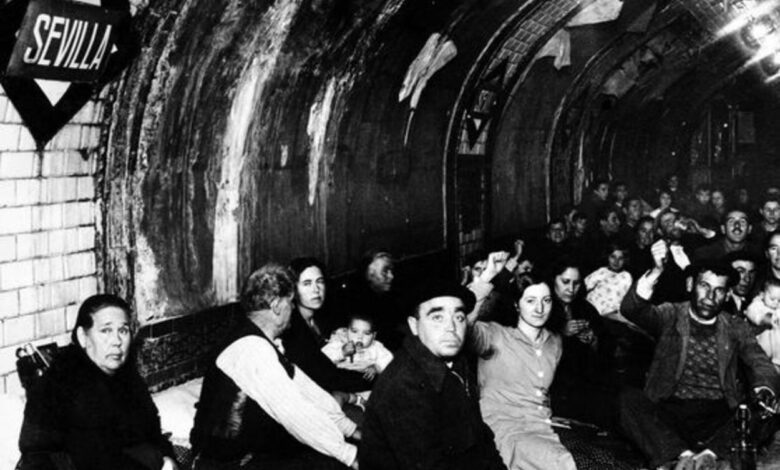
Constant bombardment forced thousands of residents to seek shelter underground. Authorities allowed the use of stations only as a temporary refuge, but many families who had lost their homes stayed there for weeks. Makeshift sleeping areas began to appear on the platforms, and people brought food and basic necessities with them. Soon, the authorities started to clear out the shelters: women and children were handed over to social services, while men of conscription age were sent to the front. Those hiding from justice were detained and turned over to the police.
Amid the chaos and shortage of resources, an entire subculture emerged in the metro. For example, there was the so-called ‘beret mafia’: people sold berets at the entrance so anyone could pass as a soldier and ride the metro for free. As a result, the metro’s revenue plummeted, and soon a strict rule requiring everyone to pay for their fare, regardless of attire, was imposed.
Legacy of War: Forgotten Pages of History
The war years were a time of trial and change for the Madrid metro. The underground not only saved lives, but also became a battleground, a place of tragedy, and a testament to human solidarity. Many episodes from that time remain little-known, and the stories of those who worked and lived below ground are only now beginning to surface thanks to new research and eyewitness accounts.