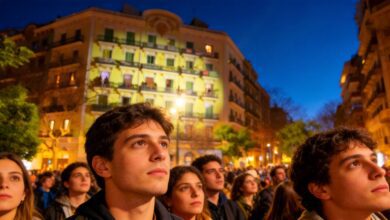
In the heart of Barcelona, inside Argentina’s consulate, an unusual exhibition unfolded dedicated to the fifth anniversary of Diego Armando Maradona’s death. On November 25, not only Argentinians but also locals gathered here to remember the football legend and immerse themselves in an environment where sport and art become one. The consulate’s space was temporarily transformed into a kind of cultural island, filled with emotion, memories, and symbols connected to Maradona and the Boca Juniors club.
Immersed in the Spirit of La Boca and Boca Juniors
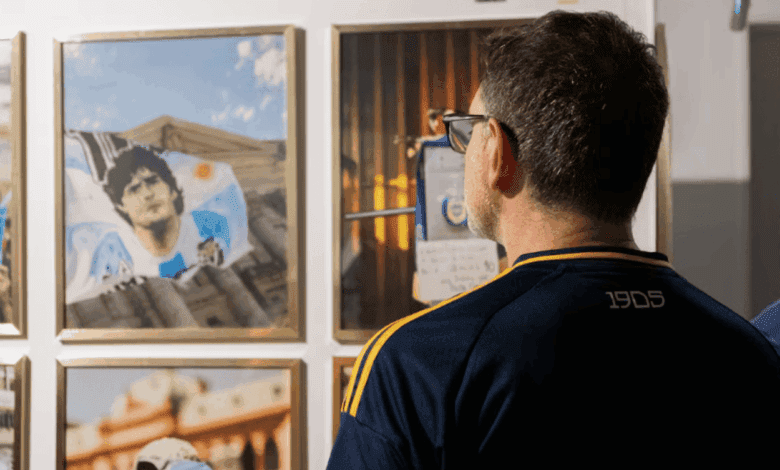
The Boca+Arte exhibition, which arrived from Argentina, brought together works by 17 artists. Visitors could see paintings, photographs, videos, and even a small altar dedicated to Maradona. Every piece tells a story about the connection between football, art, and the identity of the La Boca neighborhood, home to the famed Boca Juniors club. Guests are welcomed by the “Sanctuary of D10S” — an installation featuring a retro TV, old video clips of goals, scarves, candles, and keepsakes tied to the idol of millions.
At the exhibition’s opening, Rossana Surballe, Consul General and Ambassador of Argentina in Barcelona, delivered a speech. She reminded attendees that the consulate serves a region comprising Catalonia, Aragon, Valencia, and Andorra, where more than 180,000 Argentinians reside—almost 47,000 of them registered in Barcelona. Many came to the event wearing the blue and yellow of Boca Juniors to honor Maradona’s memory and to feel part of a larger family.
Maradona as a cultural phenomenon
The exhibition spotlights not just Maradona’s sporting achievements, but also his impact on culture and society. Organizers emphasize that for many Argentinians, Maradona is more than just a football player—he is a symbol of national identity, someone who brought people together and gave them a sense of pride. Project curator Camila Rabinovich noted that the exhibition aims to preserve the memory of a man who made the impossible possible, despite all his contradictions.
The exhibition takes visitors back to the origins of Boca Juniors, founded in 1905 by five Italian immigrants. The club’s blue and yellow colors were chosen in honor of a Swedish ship that was the first to dock in the port of La Boca. The nickname ‘xeneize’ recalls the Genoese roots of the founders. This is all part of a story of migration, the search for a home, and a sense of belonging—so important to the Argentine diaspora.
Football, art, and memory captured in photographs and installations
At the center of the hall stands a cube adorned with photographs, where the works of Pancho Monti capture the unique bond between fans and Maradona. The images convey the passion at La Bombonera stadium, which, as Diego himself once said, doesn’t just vibrate — it ‘beats like a heart.’ The display also features farewell scenes to Maradona in both Buenos Aires and Naples, where he played from 1984 to 1992 and became an almost religious figure. His Barcelona chapter is not forgotten: despite injuries and illness, Maradona left his mark on local football history and in the hearts of fans.
Artist Bruno Acanfora reinterprets classic works of art by adding Boca Juniors symbolism. Photographer China Sanjuán captures the energy of fans in the stands, while Ciro Pipoli’s works unite scenes of mourning from Naples and Buenos Aires. Additional footage is shown on screens, and a dedicated installation by Damián Cukierkorn tells the story of Maradona’s life through portraits of ordinary people.
A connection between two cities, a cultural bridge
The exhibit’s curator notes that the project helps create a sense of unity and belonging, especially for those living far from home. Boca+Arte runs until December 12 — celebrated as Boca Juniors Fan Day. Throughout this period, visitors can attend master classes and extra events.
The choice of Barcelona as the venue for the exhibition is no coincidence. Like Buenos Aires, the city was shaped by migration and water—Riachuelo and the Mediterranean Sea. Two cities separated by thousands of kilometers, yet united by a shared history, a passion for football, and a culture reflected in art and the memory of a legendary player.