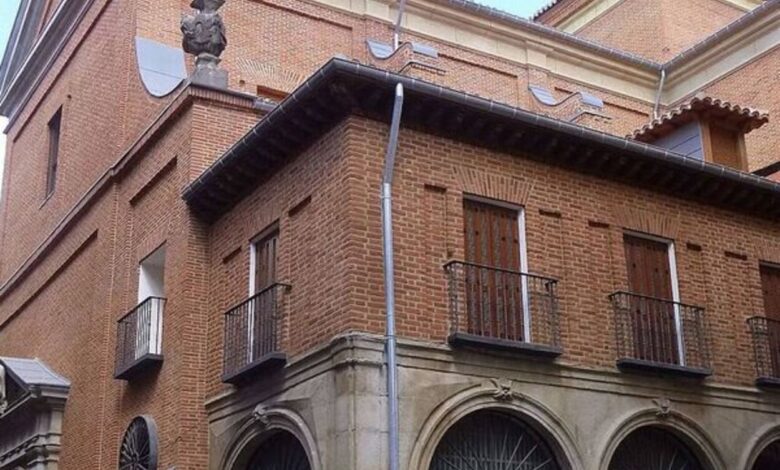
In the heart of Madrid’s Malasaña district stands a church passed by hundreds every day, unaware of its dramatic past. Here, in Dos de Mayo Square, the defense of the city against French troops began in May 1808. The Baroque church, known as the Church of Nuestra Señora de las Maravillas y los Santos Justo y Pastor, was not only a witness but also an active participant in key events of Spanish history.
The building, constructed in 1628 by architects Juan Gómez de Mora, Antonio de Herrera, and Alonso Carbonel, has been rebuilt several times. In the 18th century, its façade acquired neoclassical features thanks to Miguel Fernández and Francisco Gutiérrez, who also worked on the famous Puerta de Alcalá and the Cibeles Fountain. Originally, the church was part of the Carmelitas Calzadas monastery, which, according to legend, had existed here since 1616.
According to legend, the church got its name from a statue of the infant Jesus found among the flowers known as maravillas in the monastery garden. After the monastery was demolished in 1868 during the district’s redevelopment, the surviving church became the local parish and preserved the memory of earlier times.
Architectural features
The church is designed in the shape of a Latin cross, featuring a flat apse and side chapels. Its facade stands out for its simplicity: brickwork, a central pediment, and distinctive curved cornices. The corner portico with its stone arches draws special attention, setting the building apart from others in the neighborhood.
In the 19th century, the church found itself at the center of historic events. Nearby stood the Monteleón Palace (Monteleón), which had been converted into an artillery arsenal. From here, under the command of captains Daoiz and Velarde, the armed defense of Madrid began on May 2, 1808. A monument in the square commemorates these events, while the preserved arch of the palace’s former stables has become one of the district’s symbols.
Transformations and changes
After the demolition of the palace and the redevelopment of the square around the surviving arch, the area gained its modern appearance. The first new-type school in Spain opened here, and the church finally lost its monastic status, becoming a parish church. Such changes were typical for many Madrid churches: following secularization and the Madoz reforms in 1855, numerous monasteries were converted into regular parishes.
In 1868, following the revolution and Queen Isabel II’s exile, the church officially became a parish and received an additional dedication to Saints Justo and Pastor. This occurred after the former church dedicated to these saints was transformed into the Basilica of San Miguel (San Miguel).
The fate of the nuns
The story of the exiled Carmelites was far from simple. Initially, they were sheltered by the nuns of the neighboring Don Juan de Alarcón monastery on Valverde Street, where they stayed until 1891. They then had to move to Obelisco Avenue (now General Martínez Campos), where they set up a small chapel. Later, due to financial difficulties, the nuns found refuge with the Comendadoras de Santiago, always bringing with them the revered icon of the Virgin Mary. The original never returned to the church—a copy had to be made.
In the early 20th century, the Carmelites built a new monastery on Príncipe de Vergara Street in the Salamanca district, which was named “Maravillas Nuevas” (New Maravillas). The building was designed by architect Manuel Ortiz de Villajos.
Modern challenges
Today, the Maravillas Church remains one of the few surviving landmarks of old Madrid. Its modest appearance and closed portico make it stand out among the surrounding buildings. However, in recent years, the building’s façade has increasingly fallen victim to vandalism. The brick and stone surfaces, in particular, suffer the most, as graffiti is difficult to remove without damaging the historical materials.
Local residents and architecture experts note that the church evokes a special sadness when seen defaced and damaged. Despite its historical and cultural significance, the church has not managed to avoid the fate of many city landmarks that lack adequate protection from modern threats.