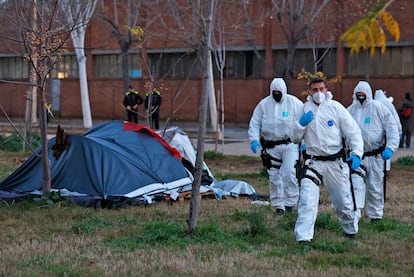
A large-scale operation has begun in Barcelona to clear out the city’s largest informal camp in the Zona Franca industrial area. The decision comes after a sharp deterioration in sanitary conditions: a rat outbreak poses a threat not only to camp residents but also to employees of nearby businesses. For the city, this is not just a hygiene issue—it’s about the safety and health of hundreds of people, as well as the reputation of the Catalan capital.
From early morning, dozens of municipal workers, police, and representatives from social organizations arrived at the camp. Residents living in gray tents along 2nd Street were warned to urgently leave their temporary shelters. Many of them are migrants from Africa, Latin America, and Eastern Europe who are in Spain without documentation. According to authorities, about 175 people lived in the camp, but by the start of the operation fewer than half remained—some had already relocated to green areas along the Ronda Litoral after receiving prior notice.
Officials say the intervention was necessary because disinfection and treatment of the area could not be carried out while people were present. City administration representatives emphasize that this is not a forced eviction, but a temporary measure to protect public health. However, many camp residents view the action as harsh, especially noting the presence of the National Police and widespread document checks.
Response and consequences
The operation involves not only city services and police, but also social workers and representatives from the Public Health Agency. Barcelona’s ombudsman David Bondia is present at the site; police officers insistently advised him to leave the restricted area. Social activists and human rights defenders criticize the scale and format of the actions, calling them excessive. According to Enrique Mosquera from Papeles para Todos, many camp residents are officially registered locally and formally eligible for legalization, yet they are being identified and risk deportation.
Commissioner for Social Policy Sònia Fuertes stresses that the aim is not eviction, but ensuring safety and a gradual solution. Since 2024, social services have been working with the camp inhabitants, and since 2025, support has intensified, now involving the Red Cross. Most have agreed to participate in social adaptation programs, but around 45 people remain outside the support system.
The special operation aims to clear the most contaminated part of the camp and carry out phytosanitary treatment. According to Zona Franca representative Pere Navarro, the rat situation has reached a critical point, posing a threat not only to residents but also to industrial zone workers. Authorities emphasize that sanitary safety is the priority, and further actions will depend on the results of the treatment.
Social context
According to official data, by December 2026, there were 1,756 people sleeping on the streets of Barcelona, around 40% of whom were citizens of non-EU countries, and half were without legal status. About 500 people were living in similar temporary camps and occupied buildings. In recent months, city authorities have carried out similar eviction and clearance operations in other informal settlements, including the neighborhoods of Vallcarca, Estació del Nord, Joan Miró park, and the Calatrava bridge.
The situation in Barcelona reflects a broader trend of rising informal settlements in major Spanish cities. Authorities are forced to strike a balance between upholding sanitary standards and protecting the rights of vulnerable groups. Social services are intervening more systematically, but the problem is far from being resolved: many people continue to seek shelter elsewhere, while the city faces new challenges.
A surge in activity by municipal services and police in such situations often sparks debate in society. Some see these measures as necessary for maintaining order and safety, while others view them as increased pressure on the most vulnerable. Looking back at recent events, it is worth noting that unexpected disruptions and emergency measures in Barcelona have repeatedly become a focal point for public debate on how the city responds to crises.
Context and trends
In recent years, Barcelona has seen a rise in temporary camps and worsening sanitary conditions in industrial areas. While similar eviction and disinfection operations have taken place before, intervention on such a large scale, involving all city services, is rare. Authorities stress that health and safety remain the top priorities, but the issue of migrant integration and support is still unresolved.
At the same time, other regions of Spain are also experiencing mass evictions from informal settlements due to sanitary concerns. In Andalusia, for instance, after devastating storms and floods, municipalities were forced to evacuate hundreds of people from temporary camps. Similar measures were taken in Madrid and Valencia in response to epidemics and the risk of infections spreading. These developments highlight how urgent the problem of informal housing and social support has become in the nation’s major cities.