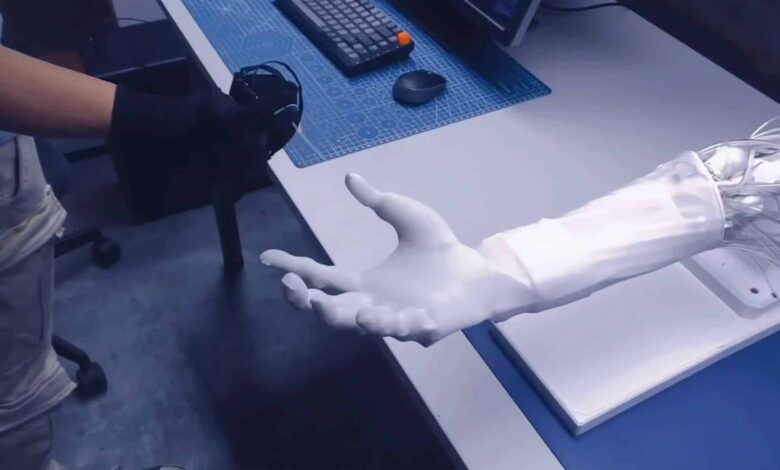
The engineering team at Clone Robotics has unveiled a prototype of an artificial hand capable of replicating complex human movements with virtually no delay. The device demonstration generated significant interest within the professional community and among robotics enthusiasts.
During the tests, the operator controlled the prosthetic using a special sensor glove. Every gesture, every finger movement, was instantly mirrored by the artificial hand resting on the table. The system responded to commands with minimal latency, allowing for exceptional accuracy and smooth motion.
The developers note that creating a fully controllable hand capable of complex manipulation remains one of the most challenging tasks in modern robotics. Particular attention was given to construction reliability and component durability. The new model features 27 degrees of freedom, enabling the hand to perform a wide range of movements characteristic of the human hand.
The speed and gripping strength of the artificial limb are comparable to a real hand. To achieve these results, engineers used innovative artificial muscles, which they claim surpass all existing counterparts in strength.
During the presentation, the Clone Robotics team emphasized that the main goal was to showcase the updated neural joint controller. Although some muscle types are missing in the current version, the developers are already working on expanding the device’s capabilities.
Experts believe that such technologies could be used not only in prosthetics, but also in industrial automation, medicine, and service robots. This new development paves the way for more advanced and adaptable machines capable of interacting with their environment in ways that were previously unattainable for artificial systems.