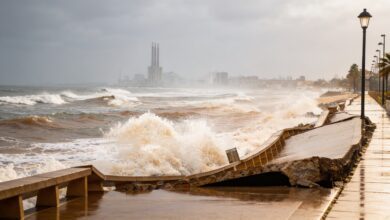
Extreme weather conditions in northern Catalonia have caused major disruptions to transport and have changed the daily routine for thousands of residents. Powerful wind gusts, reaching up to 168 km/h in Portbou, forced authorities to impose restrictions on roads and railway lines and to take emergency measures to ensure public safety. According to El Pais, the situation was further complicated by heavy snowfall in the Pyrenees, where fresh snow exceeded 30 centimeters in the high mountain areas.
On Saturday night, Protección Civil emergency services sent out Es-Alert warnings to residents in six northern comarcas: Solsonès, Berguedà, northern Cerdanya, Ripollès, Garrotxa, and Alt Empordà. The message advised people to avoid travel and any outdoor activities until the situation stabilized. Rail service between Figueres and Portbou, as well as between Vic and Ripoll, was temporarily suspended at least until 13:00, as reported by El Pais.
Restrictions and consequences
On Sunday morning, Meteocat raised the alert level to 5 out of 6 for wind, 4 out of 6 for waves along the northern coast, and 3 out of 6 for snowfall in the western Pyrenees. By 8 a.m. alone, Protección Civil had recorded 111 incidents related to wind damage in the northern part of the region. Mountain temperatures plummeted: in Ulldeter, the thermometer dropped to minus 12 degrees Celsius. Road conditions also deteriorated: travel on the BV-4024 to Coll de Pal and on the C-28 to Port de la Bonaigua was impossible due to snow, and chains were mandatory on several other routes.
The Catalonia Traffic Service has warned that chains are required on sections of the C-13 Guingueta-Esterri d’Àneu, C-142b to Pla de Beret, C-147 Esterri-Alt d’Àneu, as well as on the C-28 between Vielha, Mijaran-Naut Aran and Alt-Esterri d’Àneu. The region continues to experience a series of storms that began last autumn: snow, heavy rains, and hurricane-force winds follow one another, putting constant strain on infrastructure and residents.
Response and warnings
Authorities in Catalonia have urged residents to exercise maximum caution and stay home whenever possible. Special attention is given to road safety and preventing accidents related to falling trees and downed power lines. According to russpain.com, such weather events have already led to widespread power outages and transport disruptions in the region, as seen in February, when nine people were hospitalized and most movement in Catalonia came to a halt.
According to El Pais, the current storm is another in a string of severe weather events that have regularly hit northeastern Spain since autumn. The surge in emergency calls and temporary suspension of train services underscore the scale and seriousness of the situation. Authorities continue to monitor developments and are prepared to take prompt action if conditions worsen.
Context and recent events
In recent months, Catalonia has repeatedly faced destructive storms, resulting in accidents, power outages, and transport disruptions. For example, earlier this year, strong winds had already disrupted daily life in the region, as detailed in our coverage of the aftermath of the previous storm, when hundreds of incidents and thousands of power cuts were recorded across the northeastern part of Catalonia — more on the previous severe weather impact. Such weather events are becoming increasingly frequent, raising concerns among experts and local residents. Authorities continue to improve warning and emergency response systems to minimize damage from new storms.
For reference: in recent years, northern Spain has regularly suffered from abrupt weather changes, including hurricane-force winds and heavy snowfall. In February 2026, a similar storm caused widespread transport disruption and temporarily isolated several communities. In 2025, severe winds led to road closures, train cancellations, and damaged power lines. Meteorologists note that such incidents could become even more common in the coming years, requiring local authorities and residents to be better prepared for emergencies.