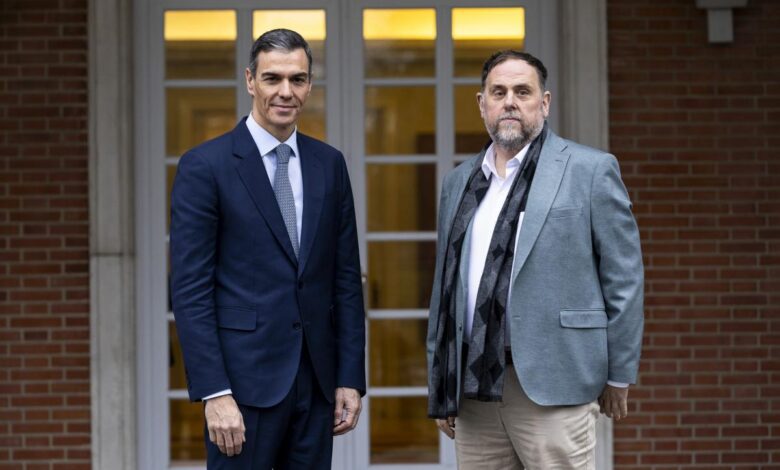
Pedro Sánchez finds himself once again at the heart of a political storm. Spain’s Prime Minister projects confidence as if he has everything under control, but behind this determined exterior lie serious challenges. This week, the government sought to seize the initiative, making bold statements on international affairs while simultaneously broaching the complex issue of regional financing reform. However, despite a flurry of activity, Sánchez faces a lack of support in Congress, and his proposals are stirring heated debate even among his allies.
The visit of Oriol Junqueras to the prime minister’s residence was a symbolic gesture meant to show a willingness to engage in dialogue with Catalonia. But the move drew mixed reactions: some saw it as an attempt to appease Catalan politicians, while others viewed it as a dangerous precedent that undermines the principle of regional equality. Sánchez appears to be betting on Catalonia by offering special conditions, yet he is quick to reassure other autonomous regions that additional funding will also be provided. This approach is fueling frustration among the opposition and even within his own party.
Financial deadlock
The government’s attempt to reform the regional financing model has turned into a real puzzle. Authorities in Catalonia have been promised a special status, while other regions—mainly governed by the opposition Partido Popular (PP)—have been offered additional billions. Both Madrid and the Finance Ministry insist that no region will lose out. Yet PP regional leaders remain wary. Suspecting a trap, they are gearing up for tough negotiations at the upcoming Fiscal Policy Council meeting.
In Valencia, Andalusia, and other regions, government representatives are actively promoting the new plan, highlighting its benefits. This is especially evident in areas where the Socialists are aiming for electoral gains. However, the opposition sees this not as genuine concern for the regions, but as a political maneuver to divide and weaken the PP. Even within Sánchez’s own party, there is discord: some barons fear that voters will not forgive concessions to Catalonia or any breach of the equality principle.
Disagreements and skepticism
Skepticism about the reform’s success is growing not only among the opposition. Even coalition partners are expressing doubts. The Catalan party Junts has already rejected the proposed model, Galicia’s BNG is not supporting the initiative, and the PP remains firm in its ‘no.’ The left is also divided: Sumar sees no prospects for the reform, while Podemos is distancing itself from the process altogether. As a result, the chances of the bill passing through Congress appear slim.
Behind the scenes, politicians admit that achieving approval for the new funding scheme before next summer is virtually impossible. Even if some MPs can be persuaded, the overall mood in parliament remains deeply negative. Several regional leaders are openly demanding early elections, arguing that the current government’s course is pushing the country towards division.
International maneuvers
While passions run high at home, Sánchez is working to strengthen his position on the international stage. In recent days, he has made several bold statements regarding Spain’s involvement in resolving conflicts in Ukraine and Palestine. In Paris, the prime minister unexpectedly announced the potential deployment of Spanish troops to Ukraine, soon followed by a similar suggestion for Palestine. However, no concrete plans back these words for now: the Defense Ministry acknowledges these are only hypothetical peacekeeping missions still far from reality.
Nevertheless, such statements allow Sánchez to shift attention from domestic issues and showcase leadership in Europe. He has been especially vocal on the topic of Venezuela, opposing interference by Donald Trump and calling for a united EU stance. Government officials believe this strategy strengthens Spain’s image as an independent player while also quelling a wave of domestic criticism.
Cracks within the party
Yet even against a backdrop of foreign policy successes, tensions are rising within the coalition. Fierce debates are underway in Sumar over whether Spain should take part in overseas military conflicts, while Podemos has already stated it will not support such initiatives. The Partido Popular, meanwhile, is maintaining a wait-and-see approach, demanding direct talks from the government and accusing it of lacking transparency. As a result, any attempt by Sánchez to advance his initiatives in parliament hits a wall of distrust and political intrigue.
The situation is further complicated by divisions among the prime minister’s closest allies, who are split on the path forward. Some urge continued dialogue with Catalonia, while others demand a tougher stance and a return to equal principles for all regions. Under such circumstances, every new move by the government sparks fresh conflict and accusations.
A test for the leader
Pedro Sánchez now finds himself in a position where every decision he makes provokes heated debate and strong emotions. On one hand, he is trying to maintain control of the political agenda using both domestic and international issues. On the other, he faces fierce resistance in parliament and growing mistrust even among allies. Spanish politics is once again teetering on the edge, and the future of the government remains uncertain.