A renewed dispute has broken out in Spain over the allocation of state funds among the autonomous communities. The leader of the Partido Popular (PP), Alberto Núñez Feijóo, has openly rejected the government’s proposed financing scheme, calling it unfair and a threat to national unity. However, despite his strong rhetoric, tension is rising within his own party: some regional PP leaders have not ruled out endorsing the new model if it is ultimately approved.
The government, led by Finance Minister María Jesús Montero, is pushing for prompt adoption of the reform, which they say will close the financial gap between regions. As expected, Catalonia has backed the initiative, while the rest of the autonomous communities are divided. At the same time, the PP is promising that if it comes to power, it will repeal the new system and propose an alternative solution that, according to Feijóo, will satisfy everyone.
But for now, with their own alternative plan still unclear, the party must balance the interests of its twelve autonomous communities—each with its own demands and expectations. Party officials at Génova admit there is no guarantee that all regional leaders will act in unison if the new scheme comes into force.
Internal divisions
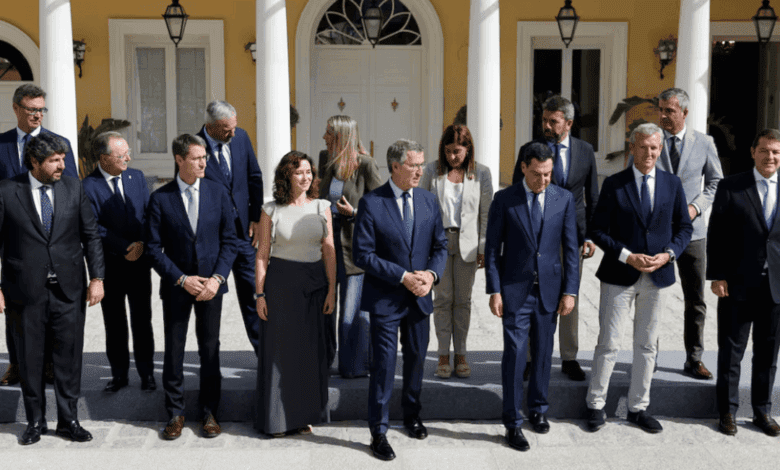
Ahead of the elections in Aragón, Feijóo is convening another gathering of party leaders in Zaragoza to show unity and determination in opposing the central government’s concessions to separatists. However, behind the scenes, far more complex questions are being discussed: how can such diverse regional interests be balanced without losing face before voters?
A similar meeting took place in Madrid in September 2024, where the document ‘España somos todos’ (We Are All Spain) was adopted. The party condemned the ‘deceitful bilateralism’ of government negotiations with Catalonia and demanded an increase in the temporary fund for all regions until a new scheme was approved. At that time, the PP insisted that no autonomous community should leave the common financing system.
Now, a year and a half later, the situation has become even more complicated. The Finance Ministry’s new proposal, agreed with ERC, promises €21 billion in additional funding for all regions. Catalonia will remain within the general system and stands to gain some of the greatest benefits. Andalucía, Comunidad Valenciana, and Murcia—all governed by the PP—also stand to benefit. The funding gap per capita is expected to be nearly halved.
Feijóo’s position
So what exactly is Feijóo proposing? According to party representatives, a general approach based on equality between regions will be presented at the upcoming congress in Zaragoza. However, no specific figures or formulas have been announced yet. The PP insists that only the government has access to all the necessary economic data for precise calculations.
Feijóo’s team admits: creating a universal model that will satisfy all regions is practically impossible. Every party baron defends the interests of their own territory, and compromise seems out of reach. “This will be a scheme where everyone gains something, but also loses something,” the party says.
Meanwhile, Minister Montero reminds that regions will be able to voluntarily join the new system if it is approved by parliament. According to her, a decision must be made by the end of the year, but political battles over the reform are only intensifying.
A Financial Divide
This story isn’t just a dispute over money. What’s at stake is the balance of power between the central government and the regions, as well as the future political map of Spain. Discontent within the PP is growing: some demand a tough stance and rejection of any concessions, while others are ready for pragmatic compromises in the interests of their voters.
While some regions see the new scheme as an opportunity to gain additional resources, others fear their interests might be sacrificed for political agreements. The question of who will ultimately benefit remains unanswered. One thing is certain: the fight for billions of euros and influence over resource distribution is only just beginning.