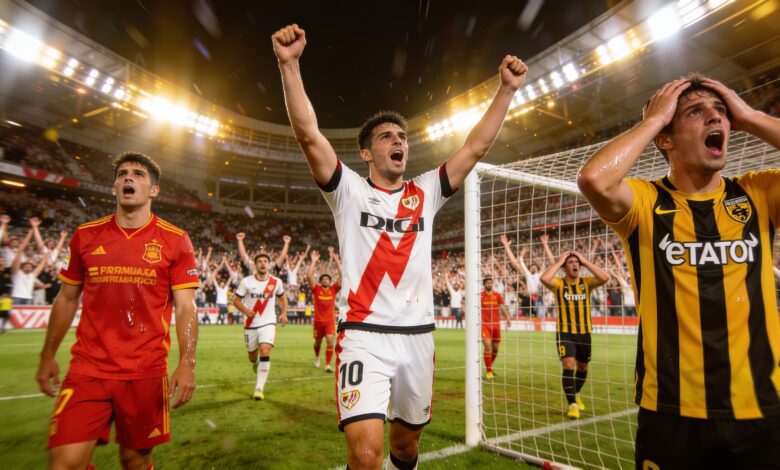
Spanish football was once again in the spotlight after the first leg of the Conference League quarterfinal between Rayo Vallecano and AEK. For fans in Madrid, the evening turned into a true test of nerves: the home side showed maximum efficiency, scoring three times in a single half. This explosive start not only strengthened Rayo Vallecano’s position in European competition, but also highlighted the crucial role of concentration for Spanish clubs in key moments.
From the opening minutes at Vallecas, the stadium buzzed with both festive and tense energy. The hosts quickly capitalized on AEK’s defensive errors, with Ilyas and Unai López emerging as the main figures of the first half. The first goal came from a fast attack down the left, with Alvarito delivering a pinpoint pass to Ilyas, who confidently sent the ball into the net. Soon after, Rayo Vallecano could have doubled their lead, but the referee disallowed the goal after a VAR review due to offside. That didn’t stop the Spaniards: following another swift combination, Unai López was first on the rebound and made it 2-0.
Pace and intensity
AEK tried to turn the game around but missed several dangerous chances. The brightest moment was Koita’s one-on-one with goalkeeper Batalla, but he failed to convert. In response, Rayo Vallecano kept up the pressure, and the third goal was a logical result of their dominance. Despite Lejeune’s disallowed goal, the hosts maintained their tempo, while the visitors’ defense looked unsettled. Towards the end of the half, tempers flared: Ilyas and Pereyra exchanged sharp words, adding further emotion to the field.
Goalkeeper Batalla saved his team several times, stopping close-range attempts. Rayo Vallecano’s defenders played with determination, preventing the opposition from converting their chances. As AS Rayo notes, the team’s confidence and the support from the stands were decisive factors for the hosts. Meanwhile, AEK captain Mantalos was injured and needed medical attention, complicating the visitors’ task.
Key moments
Throughout the first half, both teams found themselves in dangerous situations more than once. Rayo Vallecano created chances through quick transitions from defense to attack, while AEK responded with set pieces and long-distance shots. The referee tried not to interfere, allowing the players to fight until the end. There were several controversial moments, but the official maintained control of the match. According to AS Rayo, AEK coach Nikolic was cautioned for arguing with the referee, and players on both sides struggled to keep their emotions in check.
Midway through the half, Rayo Vallecano nearly found success again: after a corner, De Frutos took a shot, but visiting defender Relvas blocked it. In the counter-attack, AEK’s Jovic almost equalized, but Lejeune covered for his teammates just in time. Overall, the first half was marked by high intensity and constant shifts in momentum, making the game unpredictable.
Impact on European competition
The advantage Rayo Vallecano gained in the first half could be decisive in the battle for a Conference League semifinal spot. According to RUSSPAIN.COM, the Spanish club’s chances for the trophy are estimated at 11.82%, making them one of the tournament favorites. Notably, such achievements by Spanish teams in European competitions are not uncommon: recently, Betis also made a historic run to the Europa League quarterfinals, which was covered in detail in the article about Betis’s decisive match against Braga.
The second half of the match promises to be just as intense, as AEK has no intention of giving up without a fight. The visitors’ coaching staff are preparing changes, and fans are awaiting the continuation of this football spectacle. In matches like these, details often prove crucial: injuries, substitutions, and players’ mental resilience. According to AS Rayo, both teams go into the second leg highly motivated.
In recent years, Spanish clubs have regularly reached the decisive stages of European tournaments, demonstrating a high level of preparation and tactical flexibility. One is reminded of how Real Madrid managed to turn the tide against Bayern after an early setback, and how Betis reached the Europa League quarterfinals for the first time in their history. These successes highlight the strength of Spanish football on the international stage and sustain fans’ interest across the country.