The election results in Castilla y León sent an important signal to all of Spain. Changes in the balance of power affect not only the region, but also reflect broader national trends. As El Pais notes, right-wing parties have strengthened their positions but failed to secure an absolute majority, while the left has seen a significant drop in support.
Parties and coalitions
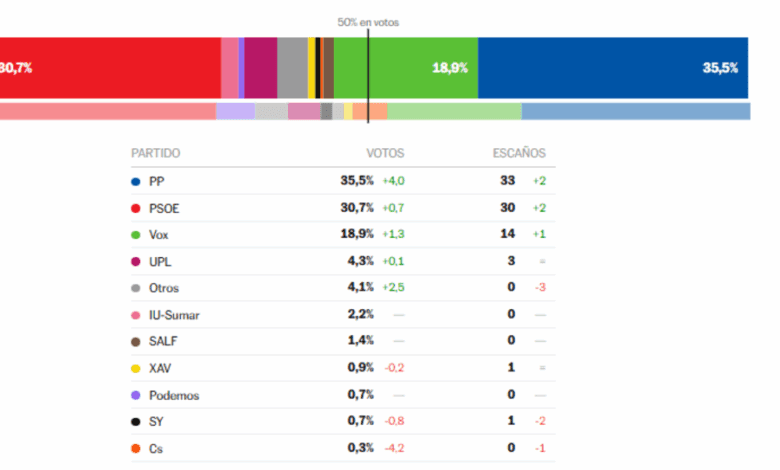
The Partido Popular (PP) once again led the vote, winning 33 seats in parliament. However, to form a government, they will need Vox’s support, as they are nine seats short of an absolute majority. Talks between PP and Vox leaders have already begun, with both sides expressing willingness to negotiate. A coalition with PSOE is barely being considered due to political disagreements and the track record of previous years.
The combined result for right and centrist parties was a record: PP, Vox, and Se Acabó la Fiesta (SALF) together won over 55.8% of the votes. This is the highest figure in decades. In 2022, similar parties received 53.5%, which was already considered high at the time. Now, the right-wing bloc has further consolidated its position, despite PP’s support declining since the 2024 European elections.
The left’s standing
The PSOE, led by Soria’s mayor Carlos Martínez, managed to slightly improve its results compared to the previous regional elections, securing 30.8% of the vote and increasing its number of deputies. However, the current results still fall short of the party’s performance in 2007 and 2011, when it reached up to 38%. Analysis by russpain.com suggests that some left-wing votes from other parties shifted to the PSOE, particularly amid weak showings by Unidas Podemos and Soria Ya.
Unidas Podemos and its allied groups have lost nearly half of their support. In 2022, their coalition received 5.1%, but after splitting into two separate groups, they failed to even reach 3%. In some provinces, such as Valladolid, combining their votes could have brought them closer to securing a seat, but this did not happen. A similar situation was seen in other regions where left-wing parties could not agree on a single list.
Vox dynamics and the national context
Vox continues to expand its influence, although the pace of growth varies across regions. In Castilla y León, the party increased its result by 5 points compared to the 2023 parliamentary elections. In other regions, such as Aragón and Extremadura, the growth has been less pronounced, since Vox already enjoyed strong support in these areas previously. Overall, the party is consolidating its position on the national stage, which is also reflected in the regional election outcomes.
Interestingly, despite the general trend towards strengthening the right, this process has slowed in Castilla y León compared to the 2024 European elections. Back then, right-wing parties received 59.1% of the votes, while now it’s about 56%. This contrasts with the situation in Aragón and Extremadura, where the right bloc continued to grow. The reason lies in declining support for PP, which secured 44.6% in the European elections and now only 35.5%.
Impact on Spain
Events in Castilla y León show that Spain’s political landscape is becoming increasingly fragmented. Building a majority now requires complex coalition negotiations, and traditional parties are losing their monopoly on power. This is reflected in other regions as well. For example, in Andalucía, the authorities have recently called early elections, sparking debate and concerns about the region’s future — more on this in the article about the new elections in Andalucía and political reactions.
According to El Pais, the electoral preferences in Castilla y León reflect national trends in Spain: growing support for right-wing parties, a weakening left, and a stronger role for new parties. This creates fresh challenges for politicians and voters, who have to adapt to a rapidly changing political environment.
In recent years, Spain has repeatedly faced situations where no party could secure an absolute majority. In 2019, a similar scenario occurred in Madrid and Catalonia, where coalition talks dragged on for months. In 2023, forming governments in Extremadura and Aragon also required complex negotiations. These examples show that the trend toward fragmentation and coalition-building is becoming the new norm in Spanish politics.