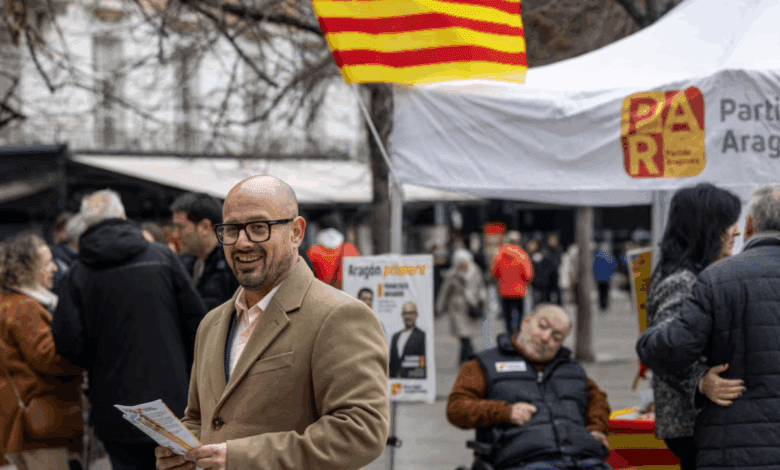
The events of recent months in Aragón have become a wake-up call for everyone following the fate of regional movements in Spain. The influence of local parties is clearly waning, while national political forces are confidently taking their place. This is more than just another shift in political trends — it signals the possible loss of the region’s unique voice on the national stage. For Aragón’s residents, this means that issues important specifically to their territory risk being pushed to the sidelines by major parties.
Street battle
In the very heart of Zaragoza, during the San Valero festival, two completely different scenes unfolded. On one hand, a line of people waited to take photos with Alvise Pérez at the table of the Se Acabó la Fiesta movement, which is just starting to make its presence felt in the region. On the other, Partido Aragonés (PAR) candidate Alberto Izquierdo handed out flyers at his party’s booth, with little success. These contrasting moments clearly illustrate the shifting political atmosphere: new players from Madrid are on the rise, while traditional regional forces are losing support.
In the most recent elections held in 2023, the combined share of votes for PAR, Chunta Aragonesista (CHA), and Aragón-Teruel Existe was only 12.1%. Sociological forecasts are bleak: support for these parties may drop below 10%, and PAR and Teruel Existe risk losing their seats in parliament entirely. For the first time in history, the region is holding elections separate from other autonomous communities, but even this has not helped regional parties draw attention back to local issues. The absence of municipal elections on the same day has also worked against them.
Lost ground
The leader of PAR openly blames the major national parties—PP, PSOE, and Vox—for pushing out regional movements. According to him, over 40 years, Spanish politicians have turned the country into a single ‘plateau,’ leaving almost no room for local forces. The decline of PAR is especially striking: in 1987, the party won 28% of the vote and even led the Aragon government. In the following years, PAR was a key partner in forming majorities, but now it is struggling to survive and risks, for the first time, not entering the regional parliament.
Internal problems have only made matters worse. After the list-rigging scandal at the 2021 congress, the party became embroiled in legal proceedings, which undermined trust even among its own supporters. Despite this, PAR still controls dozens of municipalities, has hundreds of deputies, and maintains a certain degree of local influence. However, this is no longer enough to withstand the pressure from national players.
New faces and old challenges
Amid the decline of PAR, Chunta Aragonesista is showing cautious growth. According to polls, the party could increase its parliamentary representation to five seats. Experts note that CHA is capable of attracting some voters disillusioned with Podemos and PSOE, especially in Zaragoza and progressive areas of Huesca. CHA’s candidate, 30-year-old Jorge Pueyo, has gained recognition for promoting the Aragonese language and his active presence on social media. His campaign is built on the idea of defending social rights and regional identity, without emphasizing nationalism.
CHA has decided to run independently in the elections, despite previous coalition experiences. Pueyo emphasizes that the party’s top priority is to restore trust and reclaim its former standing to once again become a significant force in regional politics. In the past, CHA was part of the Aragonese government, and now it hopes to repeat that success.
Fragmentation and uncertainty
The Aragón-Teruel Existe coalition is also facing difficulties. Polls do not guarantee a repeat of its 2023 success, when it won three seats. An active Vox campaign and declining interest in issues that were once central to the platform now threaten its standing. In rural and sparsely populated regions, where regional parties have traditionally been strong, sociological forecasts often prove inaccurate, adding further uncertainty.
Candidate Tomás Guitarte acknowledges: the lack of a united front among Aragonese parties prevents them from competing with major parties. There simply aren’t enough voters in the region to support several strong regional movements at the same time. This is one of the main features of Aragón’s political scene—fragmentation that benefits the national parties.
Future in question
The situation in Aragón reflects a nationwide trend: regional parties across Spain are losing influence amid growing polarization. For local residents, this could mean that their interests are increasingly overlooked in favor of national priorities. The question of the future of Aragonese identity remains open, and the region’s political landscape keeps changing with every new election cycle.