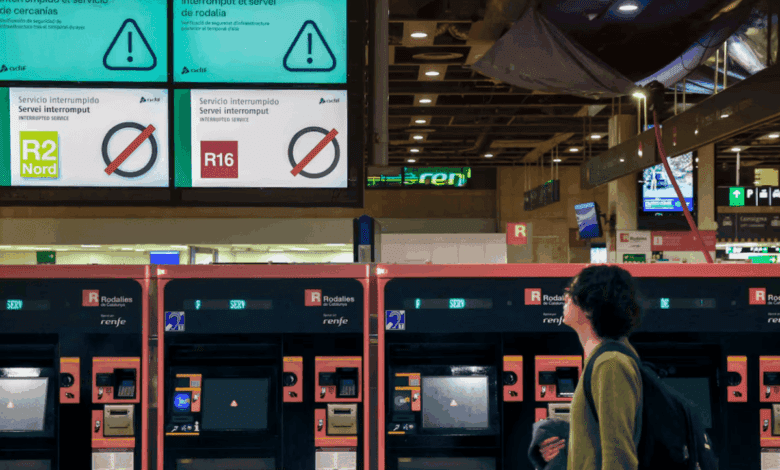
The situation with Rodalies train service in Catalonia has become a real challenge for hundreds of thousands of local residents. After a series of accidents and technical failures, familiar routes are now at risk, forcing people to urgently seek alternatives. For many, this is more than just an inconvenience—it’s a matter of survival: daily commutes to work, study, or visit loved ones have become unpredictable, and sometimes even impossible.
Forced to switch to buses, cars, or even motorcycles, Rodalies passengers are facing new costs, stress, and lost time. Some are already considering changing jobs or moving house to escape unreliable rail service. Authorities are trying to respond, but their solutions are often late or ineffective, leaving passengers living in a constant state of uncertainty.
Life on hold
Mar Carpio from Badalona travels nearly 50 kilometers every day to Sant Celoni, where she works as a pharmacist. She admits that each morning’s ride on Rodalies is a real ordeal. Disruptions on the line have become so frequent that Mar is seriously considering not only changing jobs but also moving to another city. Remote work isn’t an option for her, and staying overnight with relatives closer to her work has become a forced solution. Over the past week, she hasn’t been able to get to work at all on days when the railway was completely paralyzed. Now, Mar is exploring job openings in other areas so she won’t have to rely on Rodalies.
Joan Boada from Cardedeu has a similar story. His daily commute to Barcelona usually takes him along the R2 line, considered one of the most reliable routes. But after train cancellations, he had to switch to a motorcycle, braving rain, cold, and wind. He tries to avoid using a car due to traffic jams and expensive parking, and the bus because of high prices and long wait times. Joan notes that every day starts with tension: he never knows if he’ll be able to get to work and make it back.
No good alternatives
Aaron Hiner from Barcelona works at a tech company in Viladecavalls and commutes daily on the R4 line. He recalls one occasion when the train stopped due to a fallen tree, leaving passengers stuck in the carriages for two hours. Since then, every morning starts with anxiety—will he make it to the office today? According to Aaron, employers don’t always grasp how critical the situation is, and official messages from authorities are often contradictory. Decisions on allowing remote work can change several times a day, only adding to the chaos.
Another passenger, Diana Cruz from Gavà, found herself in an even more complicated situation. She works at a store in Barcelona, while her son lives with his father in Santa Susanna. Due to train disruptions, Diana has to switch to the bus, which significantly increases her transportation costs. According to her, daily travel expenses have risen so much that the family budget is now at risk. Diana notes that official information about public transport services often doesn’t match reality, and passengers are left to find solutions on their own.
Stress and fatigue
For students, the situation is just as tense. Judit Galí from Mollet del Vallès is pursuing a master’s degree in radio and television at a private school in central Barcelona. The only way to get to the city is by Rodalies or a packed bus she prefers to avoid. Last week, Judit missed her internship due to train cancellations and was nearly an hour late to class. Sometimes her father helps by driving her to the metro, but that’s not always possible. The constant need to monitor train updates, along with the fear of missing classes or not getting home in time, has become a source of ongoing stress for her.
The overall picture is worrying: residents of Catalonia are forced to adapt daily to new conditions, sacrificing time, money, and even their health. Many no longer believe in a quick resolution to the situation and are looking for ways to minimize their dependence on Rodalies. For some, this means looking for a new job, for others — moving, and for others still — a necessary change in their usual way of life.
Consequences for the region
The large-scale disruptions in Rodalies operations have affected not only individual passengers but the region’s economy as a whole. Employers are dealing with late arrivals, and educational institutions are facing missed classes. Drivers note increased traffic congestion, while bus passengers complain about overcrowding and rising prices. Authorities promise reforms and investment, but for most Catalonia residents, patience and temporary solutions remain the only options for now.
Until the rail system returns to stable operation, residents of the region continue to live in uncertainty, making difficult decisions and constantly revising their plans. For many, Rodalies has stopped being a reliable support and has become a source of constant stress and upheaval.