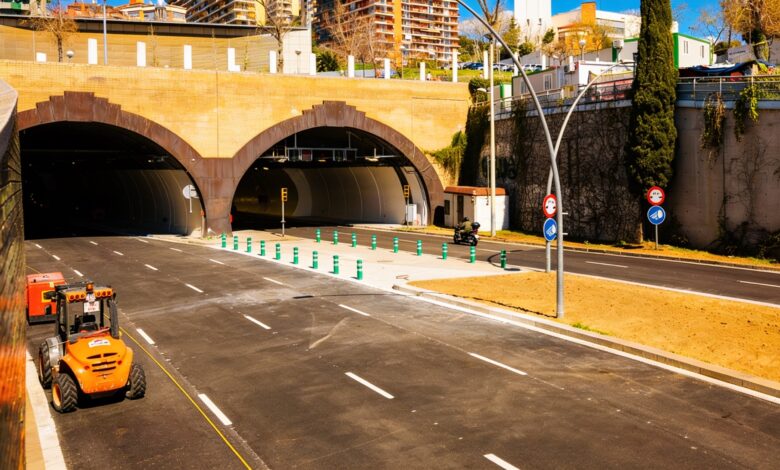
The reopening of the Rovira tunnel (túnel de la Rovira) in Barcelona after extensive renovations is a major event for city residents. Over the past year and a half, thousands of drivers have had to seek alternative routes, which has led to additional congestion and longer travel times. Now that both galleries are open again, traffic conditions in the Carmel (Carmel) and Guinardó (Guinardó) districts are expected to improve significantly, easing the pressure on alternative routes.
According to El Pais, the tunnel works began due to the need to improve safety, renew the road surface, and fix structural defects that had accumulated over nearly four decades. The infrastructure, built before the Olympics, carried up to 18,000 vehicles daily—connecting neighborhoods and providing fast access to the Ronda de Dalt (Ronda de Dalt). During renovations, the city invested over 20 million euros in the project, making it one of the largest investments in Barcelona’s transport network in recent years.
Reconstruction details
Throughout the renovation, outbound traffic from the city was maintained, albeit with restrictions: only one of the two tunnels operated during the day, while at night, complete closures were needed to install new systems. The main change is the long-awaited reopening of inbound traffic through the tunnel—the lane to the sea (sentido mar) had been closed for a year, and only now is movement returning to normal. The municipality is expected to announce the exact reopening date in the coming days.
During the reconstruction, special attention was paid to eliminating leaks that often occurred during rain. A new coating described by city authorities as ‘ultra-thin’ was used, along with reinforced waterproofing and drainage. Protective walls were built along both tunnels to prevent water infiltration. In addition, lighting, road markings were updated, and the internal steel panels were cleaned. Three connecting galleries of 42, 62, and 25 meters in length were constructed between the main tubes—these are intended for emergency evacuation in critical situations.
Safety and New Technologies
The tunnel features modern radio communication, alert, video surveillance, and fire alarm systems. New traffic lights, barriers, and emergency contact points have been installed. All these measures comply with safety standards for facilities built in the late 1980s and aim to enhance protection for drivers and passengers. As El Pais notes, after reopening, traffic in each direction will move through a separate tube, and short overnight closures may continue for several months to complete the remaining work.
Drivers who faced daily inconveniences due to the tunnel closure can now return to their usual routes. During the repairs, many had to use less convenient detours, increasing the load on other parts of the city’s transport network. In Barcelona, major works are also underway on other key roads, including the Meridiana district and plaza de Espanya, making the reopening of the Rovira tunnel especially important for urban mobility.
Impact on the city and transportation
The reopening of the Rovira tunnel is not the only major change in Spain’s transport infrastructure in recent months. In Madrid, for example, part of the metro line was temporarily closed for maintenance, with free replacement buses provided for passengers. More about how such measures affect city life can be found in the article about the temporary closure of the metro in central Madrid.
In the coming weeks, specialists will continue nighttime work in the Rovira tunnel to fully complete all technical procedures. Drivers should be prepared for possible short-term restrictions, but the main inconveniences are already over. According to russpain.com, restoring two-way traffic will help ease congestion on other city roads and speed up travel between Barcelona districts.
In recent years, Spain has been actively investing in upgrading its transport infrastructure to improve safety and comfort for residents of major cities. In 2025, Valencia completed the modernization of the tunnel under the Turia River, which also eased congestion on central streets. Seville recently inaugurated a new bridge over the Guadalquivir, while Malaga implemented a project to expand its ring road. These projects demonstrate that modernizing key transport hubs has become a priority for city authorities, especially amid rising car numbers and increasing tourist traffic.