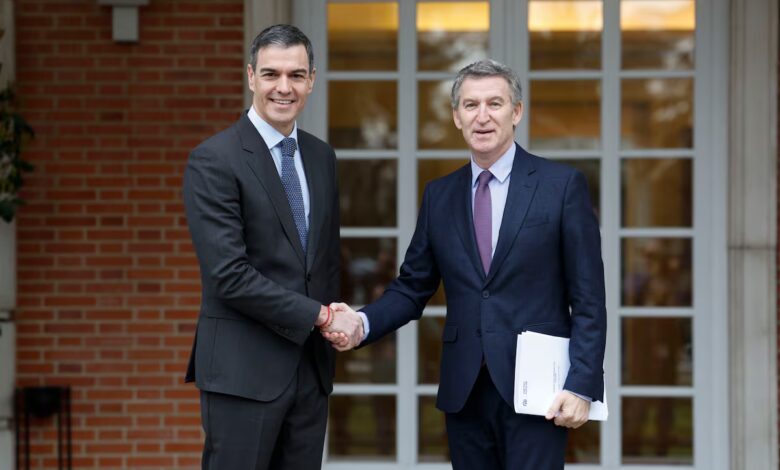
On Monday, Madrid will host a meeting that is already stirring strong emotions in political circles. Prime Minister Pedro Sánchez and opposition leader Alberto Núñez Feijóo are set to sit down together to discuss whether Spain is prepared to deploy its military to Ukraine once hostilities end. The issue goes beyond the mission itself — it touches on the core of Spain’s foreign policy principles and the question of who will make defense decisions and how.
Tensions between the two politicians are running high. In recent months, Feijóo has repeatedly criticized Sánchez in public, accusing him of trying to leverage defense issues for his own political gain. Now, with the prospect of sending Spanish troops abroad on the table, the leader of the Partido Popular is demanding a broader agenda for the meeting that goes beyond the Ukraine issue.
Political stakes
Feijóo has agreed to the talks, but immediately laid out his conditions: not only Ukraine, but Spain’s entire defense and foreign policy strategy must be up for discussion. His team insists that any support is contingent on complete transparency and a thorough debate of all details, including the budget and long-term commitments. The Partido Popular is not willing to approve isolated decisions taken out of context and demands that any military initiatives go through a parliamentary vote.
Sánchez, for his part, has no intention of backing down. He emphasizes that he is ready to brief the opposition in detail on the current security and diplomatic strategy pursued by the government. Officials insist they are acting transparently and regularly inform both parliament and the public about their actions. However, trust between the sides is at rock bottom—every move is met with mutual accusations and suspicion.
Internal party disagreements
Interestingly, even within the Popular Party there is no consensus on deploying troops. While Feijóo takes a cautious stance, his European counterparts—such as German Chancellor Friedrich Merz and Polish Prime Minister Donald Tusk—openly back the idea of a peacekeeping mission. This adds further pressure on the Spanish opposition leader, as his party champions active participation in such operations at the European level.
At a recent party congress in La Coruña, Feijóo declared he would not give the government a blank check without a detailed report on the mission’s costs and objectives. He is demanding explanations for every decision and every euro spent on defense. His allies go further, accusing Sánchez of using national security to distract from domestic issues and corruption scandals.
Parliament and coalitions
The decision to send Spanish troops to Ukraine cannot be made without parliamentary approval. The situation there is complicated: the socialists face resistance not only from the opposition, but also from some of their own coalition partners. Some parties, like Sumar, are open to discussing participation in a mission to oversee peace agreements, but others—such as Podemos and BNG—are categorically opposed.
Meanwhile, the Basque Nationalist Party (PNV) and EH Bildu are taking a wait-and-see approach, reluctant to give any clear answers. Sánchez must navigate between various interests to secure the needed majority. This is happening amid other contentious issues—such as recent changes to tax policy for landlords, which have also sparked debate within the coalition.
International context
Spain is not acting in a vacuum. The entire initiative to send peacekeepers is part of a broader European mission that is expected to begin once a ceasefire is established in Ukraine. The plan is to dispatch instructors, engineers, deminers, and observers to help restore Kyiv’s defense infrastructure. However, there is still no clear consensus even within Spain, let alone a unified position across the EU.
Sánchez has also stated his willingness to send Spanish troops to Palestine if a peace agreement is reached there. This further complicates the situation: Spain risks becoming involved in several international missions at once, raising concerns among some politicians and segments of society.
A test for leaders
The meeting between Sánchez and Feijóo could prove to be a turning point for Spanish politics. On one hand, the country’s international commitments and reputation are at stake. On the other—the internal divisions that could paralyze decision-making. Both leaders are taking risks: Sánchez could lose support even among his allies, while Feijóo risks ending up isolated in his own party and on the European stage.
One thing is clear: compromise will come at a high price and the outcome of the talks is impossible to predict. Spain faces a choice that will determine its role in Europe and the world for years to come.