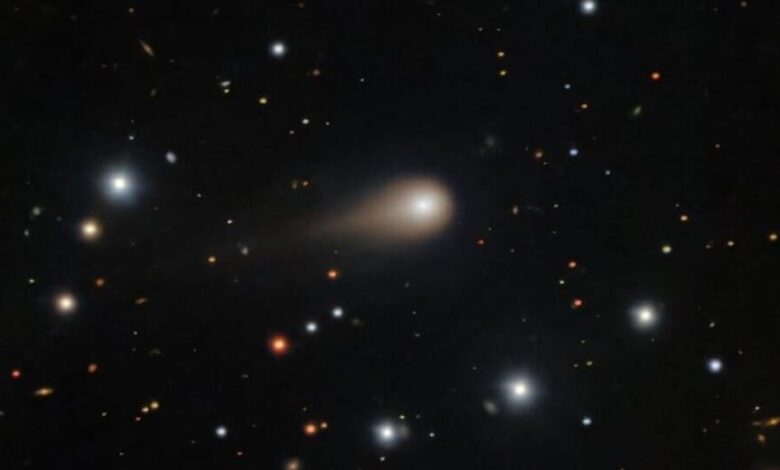
The interstellar comet 3I/ATLAS is once again drawing the attention of astronomers. It is currently traveling at a considerable distance from the Sun—about 230 million kilometers away. This distance explains why it takes almost four days for a cloud of solar plasma to pass through the comet’s trajectory. Such events are extremely rare, and experts are closely monitoring every change in the object’s behavior.
Previously, 3I/ATLAS had already encountered powerful solar matter ejections while passing behind the Sun. At the time, scientists noted that plasma exposure could seriously affect the comet’s structure and orbit. Despite these concerns, the object successfully traversed the dangerous region, although its trajectory shifted and its brightness increased compared to earlier calculations.
Now, as the comet once again comes under the influence of another plasma cloud, researchers have a unique opportunity to observe the consequences of this process almost in real-time. Since 3I/ATLAS is visible from Earth, astronomers can track even the slightest changes in its appearance and behavior. However, due to the vast distance and limited telescope resolution, spectacular images are not to be expected.
Nevertheless, even modest observations can provide valuable insights into how interstellar objects react to extreme conditions within the Solar System. Such studies help deepen our understanding of cosmic processes and expand our knowledge of comets arriving from other star systems.
In the coming days, scientists will continue to monitor the situation. Any changes in the brightness, structure, or trajectory of 3I/ATLAS will be carefully documented and analyzed. The data obtained could form the basis for new theories about the interaction of interstellar objects with solar activity.