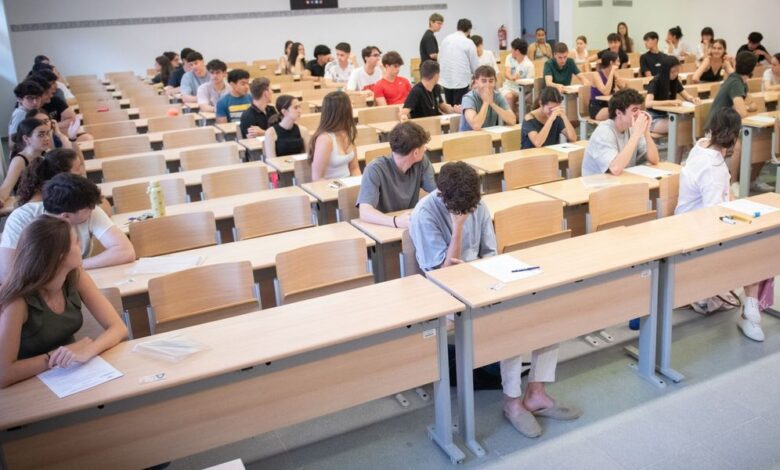
Major changes to university entrance exam schedules are expected in Spain in 2026. Several autonomous communities have decided to shift the exam dates, introducing a new timetable for high school graduates. Although the final deadlines have yet to be approved at the national level, it is already clear that the established routine is being altered.
Murcia, the Canary Islands, and Castilla y León were the first to announce the new dates. In these regions, exams will begin in early June, setting a precedent for other areas of the country. This trend towards rescheduling emerged in 2025, but now it is becoming widespread. For future students, this means not only an earlier end to the school year, but also the need to start preparing sooner for this crucial stage of their academic journey.
On the Canary Islands, exams will now be held from Tuesday to Friday, rather than concluding on Saturday as before. In Madrid, exact dates have not yet been set, but universities are already planning to begin the exams on the first Monday of June and finish by Friday. This approach will avoid exams on weekends, making it easier to review papers and release results.
In October and November, organizers from each university district will publish sample exam tasks for all subjects. Committees will include teachers from schools and universities, as well as representatives from educational authorities. They will determine the content and structure of the 2026 exams.
Changes in Exam Structure and Assessment
In the near future, exams will become more practice-oriented. In subjects such as art history or Spanish language and literature, 80–100% of tasks will be based on real-life situations. In mathematics and geography, the practical component will account for at least half of the test. In addition, a unified approach to task selection will be implemented nationwide: for instance, mathematics graduates will be able to choose between two sets of questions, and in some subjects, up to half of the exam may be elective.
An important new measure concerns the rules for penalizing spelling mistakes. Now, regions can decide for themselves how to sanction typos, but in subjects without lengthy written responses, such as physics or technical drawing, there will be no penalty for errors. At the same time, in language disciplines, the maximum deduction for spelling will remain unchanged—up to two points.
Regional Features and New Rules
Andalusia has changed the way mathematics scores are counted: if an applicant took two specialized subjects, only the best result will count towards admission. In Madrid, grades will now be awarded to the nearest tenth of a point rather than to the nearest quarter-point, as before.
All these adjustments are aimed at making the exams fairer and more aligned with modern educational standards. The new dates and rules are expected to streamline the admissions process across the country and make life easier for both applicants and educators.
Exam calendar: what we know so far
At present, it is known that, in the Canary Islands, exams will take place from June 2 to 5; in Castilla y León—from June 2 to 4; and in Murcia and Andalucía—also from June 2 to 4. In Aragón, the main session is scheduled for those same dates, with an additional session at the end of June and beginning of July. These timelines will likely serve as a reference for other regions that have not yet announced their decisions.
Thus, Spain is moving towards a more coordinated and modern university entrance exam system. For future students, this means new challenges, but also greater transparency in the admissions process.