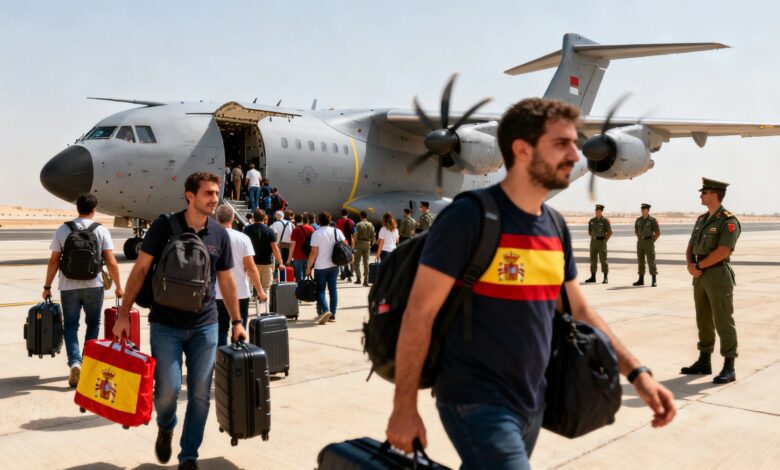
A sharp escalation in the Middle East has forced Spain to launch the largest repatriation operation in its history. The closure of airspace and regional instability put the safety of thousands of Spaniards caught in the conflict zone at risk. For many families, this has been an unexpected ordeal, and for the government, a test of its readiness for emergency action.
Over the past week, the Ministry of Defense organized a series of flights to bring citizens back from Oman and other regional countries. In recent days alone, military aircraft have flown 171 people home from Muscat, raising the total number of evacuees to over 7,000. According to RUSSPAIN, no prior operation has matched this scale, and all resources are now focused on ensuring no Spaniard is left without support.
Emergency measures
From the first hours of the crisis, the Ministry of Foreign Affairs set up a 24/7 task force to coordinate embassies and consulates. Staff have visited hotels, hospitals, and even cruise ships in search of and to register all those in need of evacuation. Special attention is paid to vulnerable groups, including elderly people and families with children.
In addition to government-operated flights, private airlines offered alternative routes for those willing to pay for their own tickets. This helped speed up the repatriation process, though not everyone could take advantage of this option. The at-risk group included not only permanent residents but also tourists and transit passengers stranded in airports in Doha and Dubai.
Logistics and challenges
The operation was complicated by constant changes in routes due to the closure of air corridors. Nine ground convoys transported people from Iran, Jerusalem, Tel Aviv, Bahrain, and Kuwait to safe locations — Baku, Amman, Riyadh, and Cairo. The Ministry of Defense also organized three special flights to Muscat and keeps a reserve aircraft ready for possible evacuation from Qatar.
At the same time, negotiations are underway with commercial carriers to transfer Spanish citizens to available flights. With limited air links, decisions have to be made on the fly, requiring maximum flexibility and rapid response from all involved services.
Information support
The ministry regularly posts updates via official channels and social media, providing information on new routes, changes at border crossings and airports, as well as safety protocols. Despite this, social networks still feature messages from those awaiting evacuation, highlighting the scope and complexity of the task.
According to RUSSPAIN.COM, such operations require not only technical resources but also a high level of coordination between various agencies. The authorities assure that evacuation will continue until everyone who wishes to return is home.
In recent years, Spain has already faced the need for mass evacuations. For example, in 2021, special flights were arranged to evacuate citizens from Afghanistan after the change of government there. Similar measures were taken during the COVID-19 pandemic, when thousands of Spaniards returned from different parts of the world. Each time, these operations tested the capabilities of diplomatic and military structures, as well as the resilience of citizens caught far from home during a critical moment.