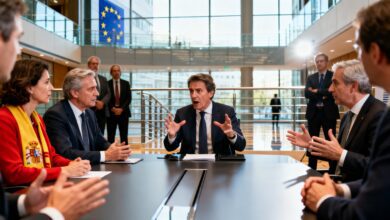
The situation surrounding Spain’s exclusion from the informal EU leaders’ meeting could have long-term consequences for the country’s standing in European politics. Italy’s decision not to invite Pedro Sánchez to the coordination gathering ahead of the summit at Alden Biesen Castle in Belgium triggered noticeable tension between Madrid and Rome. For Spaniards, this is more than just a diplomatic incident — it concerns future influence on EU decisions and how informal alliances are shaped, alliances that could determine the economic and political agenda for years to come.
The meeting, organized by Italy, Germany, and Belgium, brought together most of the key EU leaders—except Spain. According to the Spanish government, the very format of these closed-door consultations goes against the principles of equality and transparency on which the European Union is founded. Spain had already voiced its disagreement with the idea of such gatherings, considering them divisive and potentially weakening to the bloc’s unity. The Italian side, on the other hand, argues that Sánchez and Meloni already had the opportunity to exchange views at the main summit, and that Spain’s lack of invitation was due to Madrid’s stance on the validity of such events.
Internal tensions
Tensions between the two countries are escalating against the backdrop of a complex international environment. Sánchez, who has recently been openly critical of Donald Trump and his supporters, is preparing to address the Munich Security Conference with a speech emphasizing the need for greater European autonomy. Meanwhile, Meloni maintains close ties with the American leadership and influential figures such as Elon Musk, highlighting the contrasting strategic approaches of the two leaders.
Within Spain, the situation is sparking lively debates. Many experts point out that such exclusions could lead to the formation of new informal groups within the EU, with Spain at risk of being sidelined. Another recent controversy comes to mind: unexpected confessions and documents, handed over without Sánchez’s knowledge, became a turning point in an investigation, as previously covered in the article about the unexpected details of Cerdán’s interrogation.
Economic and political stakes
At the Alden Biesen meeting, participants discussed issues that directly impact the future of the European Union: the completion of the single market, regulatory simplification, lowering energy prices, and crafting pragmatic trade policies. The participants agreed to continue working in this format at the next meeting in March, which could cement a new order of informal cooperation among EU countries.
Spain, despite participating in the main summit, was notably absent from the key group photo featuring nearly all major European leaders. This symbolic omission could serve as a signal to other countries and reinforce the sense of Madrid’s isolation in matters concerning the future of the EU’s economic development and strategic initiatives.
Context and consequences
At a time when Europe faces global challenges and competition from the US and China, any signs of division within the EU can have serious consequences. Spain insists on the need for transparency and inclusivity in decision-making, yet practice shows that informal alliances and backstage agreements are becoming increasingly common.
In the near future, Spain is expected either to continue boycotting similar meetings or be forced to seek new formats to protect its interests. The Italian initiative, supported by Germany and Belgium, could set a precedent for the emergence of new centers of influence within the EU, where Madrid’s role will depend on its ability to adapt to changing rules of the game.
In recent years, such diplomatic tensions between EU countries have become increasingly common. For instance, in 2024, France and Poland also found themselves on opposite sides due to informal consultations on energy issues. In 2025, Germany and the Netherlands held a closed meeting on EU budget reform, causing discontent among several Southern European countries. These episodes indicate that informal alliances and behind-the-scenes negotiations are becoming the new norm in European politics, while countries not participating in them risk losing influence over key decisions.