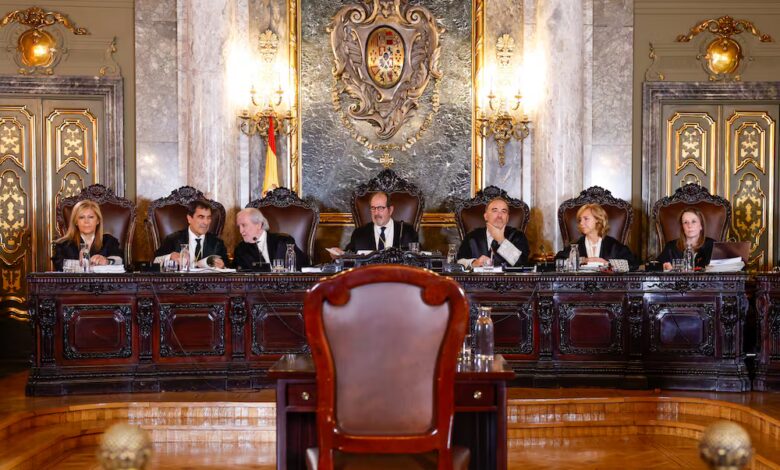
Spain’s Supreme Court has found itself at the center of public attention following a verdict in a case marked by controversy from the outset. The court’s decision, reached without clear or compelling evidence, has cast doubt not only on the proceedings themselves but also on the legitimacy of the country’s judicial system. Many observers note that such situations only deepen distrust in institutions of authority and undermine the foundations of the rule of law.
Typically, judicial authorities are expected to put an end to even the most complex and ambiguous cases so that society can move forward. However, this time, the final decision is far from clear-cut. Instead of acting as a court of last resort, the Supreme Court assumed the role of both the first and only instance, raising serious questions. This situation was made possible by specific features of Spain’s system of jurisdiction, whereby certain individuals receive a special status and their cases are tried not locally but in higher courts.
Doubts about the evidence
A key issue in this process was the lack of direct evidence. The court relied solely on circumstantial indicators which, in the view of most judges, eliminated any reasonable doubt. However, some members of the court openly disagreed with this approach, stressing that the decision was based on subjective beliefs rather than objective facts. As a result, the verdict was not unanimous but passed by a majority vote, which only heightened the sense of injustice.
Of particular note was the several-week gap between the verdict announcement and the release of its reasoning. The official explanation cited concerns over potential information leaks from within the court itself. This approach puzzled both experts and the public, as transparency and timeliness are among the fundamental principles of justice.
The role of political factors
The influence of political forces on the legal proceedings was no less significant. Court members appointed by bodies under the control of political parties came under heavy criticism. This led to suspicions that the decision may have been made under outside pressure rather than based on law and facts. In particular, there was notable discontent over the court’s choice to pursue the least likely scenario for the prosecution while ignoring other possible explanations.
During the proceedings, it emerged that the defendant had allegedly passed information to the journalist in just a few seconds—a scenario that seems highly implausible. Judges who upheld the conviction referred to supposed “assumptions” about prior contact, but no concrete evidence of this was presented. Dissenting judges called this a mere “guess” rather than a substantiated body of evidence.
Questions of journalistic ethics
The court’s view of journalists’ role in the case became a separate issue. The court’s ruling includes a lengthy discussion about journalists’ right to protect their sources, but ultimately concludes that this right enables them to distort facts. Several judges strongly disagreed, noting that source confidentiality does not grant license to lie. Had the court had solid grounds to believe the journalist had lied, it could have prompted a separate investigation—yet no such steps were taken.
Instead, the court relied on hints and conjecture without presenting a single piece of direct evidence. This became yet another argument put forward by critics who claim the proceedings were biased and failed to meet the standards of a fair trial.
Consequences for society
The high-profile Supreme Court decision not only failed to resolve the conflict, but also fueled a new wave of mistrust toward the judicial system. Many citizens are now questioning how independent judges truly are, and who actually makes the key decisions in the country. As political interests increasingly intersect with court proceedings, such situations become especially dangerous for stability and public trust in state institutions.
More legal proceedings lie ahead, possibly even at the international level. European courts may be forced to review this case to evaluate the actions of their Spanish counterparts. Meanwhile, society continues to follow developments closely, expecting fair and transparent rulings.
In case you didn’t know, Manuel Cancio Meliá is a prominent Spanish lawyer, professor of criminal law at Universidad Autónoma de Madrid, and a permanent member of the General Codification Commission. His opinions often spark significant debate both among professionals and the broader public, especially regarding issues of judicial independence and the rule of law in Spain.